Kruger 2026: Discovery Physics at the LHC

→ Africa/Johannesburg
Kruger National Park

Kruger National Park

Kruger National Park, On The Sabi River
Isobel Kolbe (University of the Witwatersrand (ZA)) , Siegfried Fortsch (iThemba LABS)
Description

Deadline for booking accommodation has passed. Kindly make a reservation asap if you have not done so already.

Second Announcement

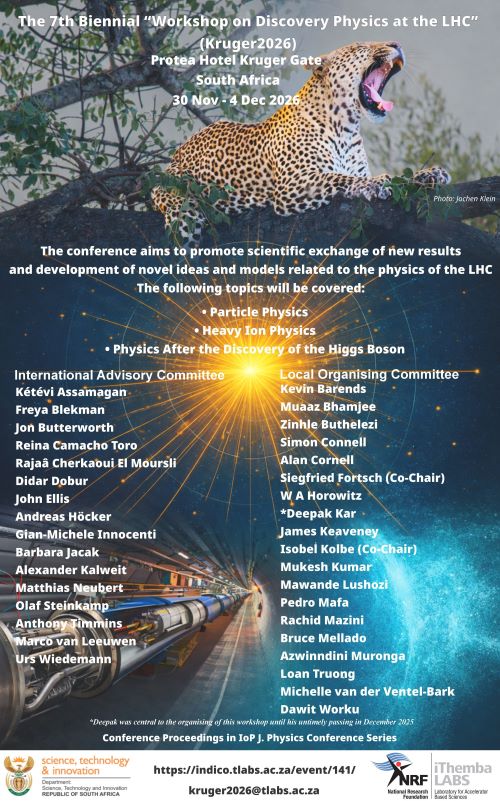
We are pleased to announce the 7th Biennial “Workshop on Discovery Physics at the LHC” (Kruger2026).

The Workshop will be held from 30 November - 4 December 2026 at the 4-star Kruger Gate Hotel, just 100 metres from the entrance of the Kruger National Park. 

Attendance will be limited to approximately 100 participants.

The world-famous Kruger National Park is the ideal location from which to experience the abundant wildlife first-hand, and one of the top-rated tourist attractions in South Africa.

The conference aims to promote scientific exchange of new results and development of novel ideas and models related to the physics of the LHC. The following topics will be covered:

• Particle Physics

• Heavy Ion Physics

• Physics After the Discovery of the Higgs Boson

Conference Proceedings in IoP J. Physics Conference Series

Attendance will be limited to about 120 participants because of the number of available rooms. Limited funding for South African students is available.

Registration fees for the conference is 9800 ZAR

We look forward to seeing you all in South Africa and do not hesitate to contact us on: kruger2026@tlabs.ac.za


LOC Poster

The organizers of Kruger2026:

K Barends
M Bhamjee
Z Buthelezi
S Connell
A S Cornell
S Fortsch (Co-Chair)
W A Horowitz
J M Keaveney
I Kolbe (Co-Chair)
M Kumar
M Lushozi
P Mafa
R Mazini
B Mellado
A Muronga
L Truong
M Van Der Ventel-Bark
Dawit Worku


Registration
Kruger2026 Registration form
Participants
  • Abdool Sattar Cassim
  • Alan Cornell
  • Aldo Deandrea
  • Amine Ahriche
  • Andy Buckley
  • Antonio Carlos Oliveira da Silva
  • Blazenka Melic
  • Brenton Suriah
  • Chiara Le Roux
  • Christian Gutschow
  • Claire Antel
  • Claire David
  • Coleridge Faraday
  • Dawit Worku
  • Edward Nkadimeng
  • Elena Bratkovskaya
  • Elena Kisel
  • ELIAS SIDERAS-HADDAD
  • Farelanani Tshwaranang Makatu
  • Farid Ould-Saada
  • Federico Lombardi
  • Filip Krizek
  • Francesca Damiola
  • Francesca Pastore
  • Garance Wilkens
  • Giulia Zanderighi
  • Giulio Umoret
  • Govert Nijs
  • Greg Landsberg
  • Hava Schwartz
  • Henric Wilkens
  • Ilia Zimin
  • Ivan Kisel
  • Ivana Momo
  • Jack Van Holland
  • Jan Fiete Grosse-Oetringhaus
  • Johanna Gramling
  • Karabo Mosala
  • Karl Jakobs
  • Kate Shaw
  • Krystian Roslon
  • Lerothodi Leeuw
  • Lungisani Phakathi
  • Marianna Fontana
  • Marie Cassing
  • Martha Mashao
  • Mateus Reinke Pelicer
  • Matthias Neubert
  • Mawande Lushozi
  • Melissa Van Beekveld
  • Milada Margarete Muhlleitner
  • Mpho Gololo
  • Muaaz Bhamjee
  • Muhammed Yasser Rasool
  • Mukesh Kumar
  • Othmane Mouane
  • Petr Baron
  • Phuti Rapheeha
  • Rens Roosenstein
  • Riccardo Bellan
  • Risa Ushioda
  • Sanele Scelo Sanele
  • Siegfried Fortsch
  • Simon Connell
  • Tamas Almos Vami
  • Thi Ngoc Loan Truong
  • Tiaan van der Merwe
  • Timothy Brooks
  • Tshepang Pule
  • Vladimir Baranov
  • Will Horowitz
  • Xin-Nian Wang
  • Xola Mapekula
    • 08:30 → 09:00
      Registration
    • 09:00 → 10:00
      Opening
    • 10:00 → 11:00
      Plenary

      Contains all tracks

      • 10:00
        Jets and Heavy Flavour as QGP Probes: Experimental overview 30m

        Jets and Heavy Flavour as QGP Probes: Experimental overview

        Jets and heavy-flavour particles are powerful probes of the quark-gluon plasma (QGP) created in heavy-ion collisions at the LHC.Their production rates, angular anisotropies, and internal structure provide insights into parton energy loss, medium-induced modifications of parton showers, heavy-quark transport, and hadronization in strongly interacting matter. This presentation will provide an overview of selected recent results from the ALICE, ATLAS, CMS, and LHCb experiments. Topics include measurements of jet suppression, studies of heavy-flavour-tagged jets, and recent experimental insights into the mass dependence of in-medium radiation, including the first measurement of the charm-quark dead-cone effect in heavy-ion collisions by the CMS Collaboration. Particular attention will be devoted to recent measurements of charm-hadron production and azimuthal anisotropies, which probe the coupling of heavy quarks to the QGP and the role of recombination during hadronization. Overall, these measurements provide complementary constraints on the microscopic dynamics of heavy quarks and jets in the QGP and contribute to the development of a quantitative description of parton interactions in hot QCD matter.

        Speaker: Filip Krizek (Nuclear Physics Institute of the Czech Academy of Sciences)
    • 11:00 → 11:30
      Tea / Coffee
    • 11:30 → 13:00
      Plenary

      Contains all tracks

    • 13:00 → 14:30
      Lunch
    • 14:30 → 16:30
      Plenary

      Contains all tracks

    • 16:30 → 17:00
      Tea / Coffee
    • 17:00 → 18:30
      Parallel - HI: HI
      • 17:00
        3+1D Baryon Transport and Pre-Equilibrium Dynamics in the Fragmentation Region 15m

        The next decade of heavy-ion phenomenology will be significantly shaped by the expansion of experimental reach into far forward kinematics. Upcoming detector upgrades, such as the ALICE FoCal programme and STAR forward calorimetry, require robust theoretical baselines to interpret baryon stopping in regions where standard boost-invariant models fail. We present a fully 3+1D classical transport framework for pre-equilibrium baryon number deposition within the Color Glass Condensate framework. The collision is modelled in the target rest frame as an ultra-relativistic saturated gluon sheet sweeping through a static distribution of collisionless classical coloured particles (Wong quarks). Averaging over the McLerran-Venugopalan ensemble yields the saturation-driven transverse momentum kicks imparted to the target degrees of freedom. This formulation provides analytic and semi-analytic solutions for the phase-space distribution, baryon current, and proper baryon density. By extending previous one-dimensional shockwave models to a realistic 3+1D geometry incorporating Woods-Saxon profiles, we explicitly quantify the competition between longitudinal compression and transverse expansion induced by momentum broadening. We derive a closed analytic expression for the transported baryon rapidity distribution, peaking at $y \simeq \frac{1}{2}\ln(Q_s^2/m_q^2)$. These results establish a mathematically controlled initial state baseline for forward-rapidity hydrodynamics, offering testable quantitative predictions for high-density QCD matter

        Speaker: Mawande Lushozi (University of Cape Town)
    • 17:00 → 18:30
      Parallel - Tech, QI: TT and QI
    • 17:00 → 18:30
      Parallel - Theory: Theory
    • 19:00 → 21:00
      Dinner
    • 10:00 → 11:00
      Plenary

      Contains all tracks

    • 11:00 → 11:30
      Tea / Coffee: Tea and Coffee
    • 11:30 → 13:00
      Plenary

      Contains all tracks

    • 13:00 → 14:30
      Lunch
    • 14:30 → 16:30
      Plenary

      Contains all tracks

    • 16:30 → 17:05
      Tea / Coffee: Tea and Coffee
    • 17:05 → 17:30
      Deepak Memorial
    • 17:30 → 18:30
      Poster
    • 13:00 → 14:30
      Lunch
    • 14:30 → 16:30
      Plenary

      Contains all tracks

    • 16:30 → 17:00
      Tea / Coffee: Tea and Coffee
    • 17:00 → 18:30
      Parallel - BSM: BSM
    • 17:00 → 18:30
      Parallel - HI: Higgs, EW, top
    • 17:00 → 18:30
      Parallel - Tech, QI: Tech and QI
    • 10:00 → 11:00
      Plenary

      Contains all tracks

    • 11:00 → 11:30
      Tea / Coffee
    • 11:30 → 13:00
      Plenary

      Contains all tracks

    • 13:00 → 14:30
      Lunch
    • 14:30 → 16:30
      Plenary

      Contains all tracks

    • 16:30 → 17:00
      Tea / Coffee: Tea and Coffee
    • 17:00 → 18:30
      Parallel - HI: HI
    • 17:00 → 18:30
      Parallel - Tech, QI: Tech and QI
    • 17:00 → 18:30
      Parallel - Theory: Theory
    • 10:00 → 11:00
      Plenary

      Contains all tracks

    • 11:00 → 11:30
      Tea / Coffee: Tea and Coffee
    • 11:30 → 12:30
      Plenary

      Contains all tracks

    • 12:30 → 13:00
      Closing: The 3 Angels
    • 13:00 → 14:30
      Lunch