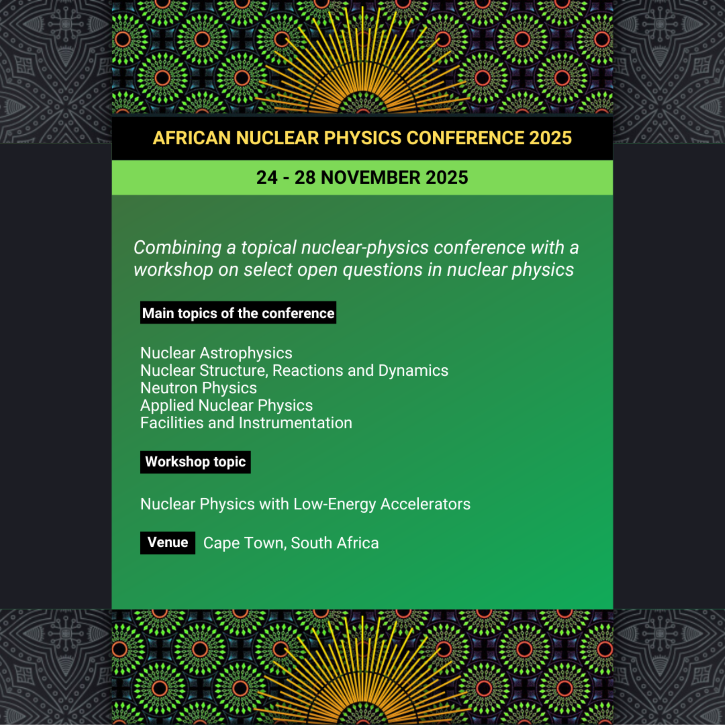
The African Nuclear Physics Conference 2025 (ANPC 2025)
- Abraham Avaa
- Adele Bakana
- AJ Mitchell
- Akaa Daniel Ayangeakaa
- Alassane Traore
- Ali Mollaebrahimi
- Andrea Richard
- Andreas Görgen
- Andreea Ghitiu
- Andrew Stuchbery
- Andy Buffler
- Atsushi Tamii
- Aurora Tumino
- Bahati Mukeru
- Benjamin Wellons
- Bo Cederwall
- Busani Bhengu
- Camelia Oliva
- Carlo Cazzaniga
- Charles Mokonoto
- Christian Iliadis
- Derjew Ayele Ejigu
- DEVARAJA HALESHAPPA MALLIGENAHALLI
- Dimitrios Papadopoulos
- DINESH NEGI
- Dmitry Kamanin
- Emanuele Vincenzo Pagano
- Esmond Craig Vyfers
- Ethan Peters
- Faical Azaiez
- Gabriela Thiamova
- Gerald Maluleke
- Gillian Arendse
- Gopal Mukherjee
- Grzegorz Kaminski
- Hesham Ali Abdelbagi Abdelbagi
- Hombakazi Wanana
- Innocent Lugendo
- Jacob Bekker
- James Smallcombe
- Jason Holt
- Jean-Marc Sparenberg
- JJ Van Zyl
- Joele Mira
- Johann Wiggert Brummer
- John Santucci
- Jorge Lerendegui Marco
- Joshua-Lee Wayne Lewis
- Kabelo Tumisi
- Kalliopi Kanaki
- Katarzyna Wrzosek-Lipska
- Katlego Malatji
- Kenjiro Miki
- Kgashane Malatji
- Khanyisa Maqwara
- Kseniia Belokopytova
- Lesedi Jafta
- Lindsay Donaldson
- Lucia Baldesi
- Lucinda Gordon
- Lucky Makhathini
- Luna Pellegri
- Luyanda Ndevu
- Mahabe Mahatikele
- Makgamathe Joseph Sithole
- MAKONDELELE VICTOR TSHIVHASE
- Mantile Leslie Lekala
- Marcin Bielewicz
- Marco Perri
- Marco Rocchini
- Mathis Wiedeking
- Mauro Romoli
- Michelle Bark
- Mick Molukie Mokwena
- Mikolaj Cwiok
- Mongi Dlamini
- Musa Maluleka
- Muzomuhle Mlotshwa
- Mzimasi Ntanjana
- Nadia Jansen- Gqibela
- Nawaal Valentine
- Nkonzo Xulu
- Nomboniselo Elma Mabotshwa
- Nyaladzi Palalani
- Oliver Wieland
- Ophir M. Ruimi
- Paolo Maria Milazzo
- Paul Vaandrager
- Peane Maleka
- Pete Jones
- Peter von Neumann-Cosel
- Philip Beukes
- Refilwe Molaeng
- Retief Neveling
- Richard Newman
- Ricky Smit
- Rudolph Nchodu
- Rudzani Nemutudi
- SANKWASA CHIKA
- SEBENZILE PRETTY ENGELINAH MAGAGULA
- Semen Mitrofanov
- Sergey Lukyanov
- Shanyn Hart
- Siyabonga Majola
- Skye Segal
- Sonia Bacca
- Soumya Bagchi
- Stephan Jonker
- Stephan Malbrunot-Ettenauer
- Sunniva Siem
- TAPUWA SITHOLE
- Thifhelimbilu Daphney Bucher
- Thomas Elias Cocolios
- Thuthukile Khumalo
- Tom Leadbeater
- Tshegofatso Bokhutlo
- Tshegofatso G Modise
- Vladimir Skuratov
- Vuako Maluleke
- Wendy Tapleni
- Willie-John Booysen
- Zina Ndabeni
-
-
09:00
→
11:15
Session 1: Opening Session Auditorium
Auditorium
Old Faure Road, Faure, Cape Town, 7100Convener: Lindsay Michelle Donaldson (SSC Laboratory, iThemba LABS)-
09:00
Welcome from the Conference Organisers and Safety Briefing 10mSpeaker: Lindsay Michelle Donaldson (SSC Laboratory, iThemba LABS)
-
09:10
Welcome from iThemba LABS 5mSpeaker: Makondelele Victor Tshivhase (iThemba LABS)
-
09:15
Keynote Address 15mSpeaker: Fulufhelo Nelwamondo (National Research Foundation)
-
09:30
The Proton Therapy Initiative at the University of Cape Town 40m
The University of Cape Town is leading the project to establish a proton therapy facility in Cape Town, near to both the Red Cross War Memorial Children’s Hospital and Groote Schuur Hospital [1]. Proton therapy centres (new and proposed) are few in the Southern Hemisphere and absent from the African continent, besides the newly established centre in Cairo, within a context where most of the population of Africa are children, and the rate of paediatric cancer cases is increasing faster than anywhere else in the world. Proton therapy ceased at iThemba LABS in Cape Town over a decade ago.
The proton therapy centre in Cape Town will also include a secondary facility for the production of short-lived radioisotopes for nuclear medicine, and beam lines for research in physics, engineering, neuroscience, radiation metrology and radiobiology.
We present a status report on the project and our vision for the facility for the whole of South Africa and the region more broadly.
[1] https://protontherapy.uct.ac.zaSpeaker: Andy Buffler (UCT) -
10:10
IAEA activities in support of nuclear physics research and applications 25m
Facilitation of development and promotion of nuclear applications for peaceful purposes and related capacity building are among the IAEA missions where Physics Section contributes most [1]. The relevant activities fall under the IAEA's program on nuclear science and cover three main thematic areas: research and applications with particle accelerators and neutron sources (incl. research reactors), nuclear instrumentation and capacity building, and controlled fusion research and technology (incl. cooperation with ITER). These efforts help Member States advance their capabilities and progress in materials research, energy, environment, food, agriculture, medicine, cultural heritage, forensics, and some other fields with a direct socioeconomic impact.
The Section also operates the Nuclear Science and Instrumentation Laboratory (NSIL) in Seibersdorf [2], south of Vienna. NSIL offers expertise, training and support for the effective utilization of nuclear instrumentation and analytical techniques in a range of applications, such as mobile radiation monitoring, X-ray spectrometry, and neutron science.
This presentation will showcase how the IAEA supports nuclear physics research and its diverse applications to address key development priorities, particularly in developing countries. It will also outline future plans for enhancing NSIL capabilities, including the establishment of an Ion Beam Facility (IBF) for research and applications using ion beams and neutrons.
[1] https://www.iaea.org/about/organizational-structure/department-of-nuclear-sciences-and-applications/division-of-physical-and-chemical-sciences/physics-section
[2] https://nucleus.iaea.org/sites/nuclear-instrumentation/Speaker: Kalliopi Kanaki (International Atomic Energy Agency) -
10:35
Low-Energy Nuclear Physics Research at iThemba LABS: Highlights from the H-Line Facility 25m
Photon strength functions (PSFs) are fundamental quantities in nuclear physics, describing the average electromagnetic decay properties of excited nuclei. Accurate PSF information is essential for modeling nuclear reactions relevant to both astrophysical processes and nuclear structure.
At iThemba LABS, a dedicated facility has been developed for low-energy nuclear physics experiments that enhance our understanding of nuclear structure, reaction mechanisms, and nucleosynthesis. In this talk, I will present experimental developments and highlight recent radiative proton and alpha capture measurements aimed at probing the shape of the PSF, testing the validity of the Brink–Axel hypothesis using (p,γ) reactions, and investigating the astrophysical important (a,γ)reactions.
This work is based on the research supported in-part by the NRF iThemba LABS of South Africa Grant Number 133636 and 118846, by the U.S. Department of Energy, Office of Science, Office of Nuclear Physics under Contracts No. DE-AC02-05CH11231 and by the US Nuclear Data Program.
Speaker: Kgashane Malatji (iThemba LABS) -
11:00
NUMEN project experimental studies with the K600 spectrometer and MAGNEX detector 15m
The NUMEN (NUclear Matrix Elements for Neutrinoless double-beta decay) project aims to obtain the nuclear matrix elements (NME) to be used as inputs in models to determine the lifetime of neutrinoless double-beta ($0\nu\beta\beta$) decay, which is related to the absolute mass of the neutrino [1]. This will be achieved by conducting heavy-ion double charge-exchange (DCE) reactions and measuring the cross sections of these reactions for all isotopes that have been identified to undergo $0\nu\beta\beta$ decay [1]. The occurrence of the $0\nu\beta\beta$ decay will imply that the lepton number is violated [2]. It is, therefore, very important to determine the NMEs as they will assist in elucidating Physics beyond the Standard Model [2]. Previous experiments for the NUMEN project at Istituto Nazionale di Fisica Nucleare - Laboratori Nazionali del Sud (INFN-LNS) have suffered from high signal rate due to the interaction of the target and projectile, which greatly outnumber any potential DCE events. Additionally, the limited energy resolution of the MAGNEX spectrometer for DCE measurements makes it a cumbersome task to decouple transitions of interest relevant to the NUMEN project. Particle-$\gamma$ coincidence measurements are a plausible attempt at a solution for this problem. Thus, a high-resolution magnetic spectrometer like the K600 at the iThemba Laboratory for Accelerator Based Sciences (iThemba LABS), which is already used for coincidence measurements, is a perfect candidate for baseline measurements especially given that the LNS facility is still under upgrade. However, in its current design, the existing K600 detection system is limited in the detection of heavy ions (e.g. $^{6}\mathrm{Li}, ^{12}\mathrm{C}, ^{18}\mathrm{O}, ^{18}\mathrm{Ne}$) at moderate kinetic energies ($\approx$ 10~MeV$/u$) and light ions at low energies ($\approx$ 5~MeV$/u$) [3]. The development of a new low-pressure detection system for the K600 is currently underway to expand the spectrometer research program [3]. Thus, an already existing detection system from the MAGNEX large-acceptance spectrometer at INFN-LNS has been coupled to the K600 for NUMEN experiments and to provide a baseline as to how the K600 will operate with a low-pressure detection system. The coupling of the MAGNEX focal-plane detection system with the K600 is also beneficial for other nuclear-structure studies to be conducted with the K600 spectrometer.
In this talk the first preliminary results of the commissioning of this setup will be presented.
[1] F. Cappuzzello, C. Agodi, M. Cavallaro, et al. The NUMEN project: NUclear Matrix Elements for Neutrinoless double beta decay. The European Physical Journal A 54, 1–46 (2018).
[2] M.J Dolinski, A.W.P. Poon, and W. Rodejohann. Neutrinoless Double-Beta Decay: Status and Prospects. Annual Review of Nuclear and Particle Science 69, 219–251 (2019).
[3] T. Khumalo. “Low-Pressure Focal-plane detector for the K600: a design study,” MSc thesis. 2020Speaker: Thuthukile Khumalo (iThemba LABS)
-
09:00
-
11:15
→
11:25
Conference Photograph 10m Outside iThemba LABS Foyer
Outside iThemba LABS Foyer
-
11:25
→
12:00
Coffee/Tea Break 35m iThemba LABS Foyer
iThemba LABS Foyer
-
12:00
→
13:05
Session 2: Facilities and Instrumentation Auditorium
Auditorium
Convener: Andrew Stuchbery (The Australian National University)-
12:00
Status of research at the FLNR, JINR 25m
The scientific programme of the laboratory includes experimental research in the synthesis and studies of nuclear physics and chemical properties of new superheavy elements, fusion and fission reactions and multi-nucleon transfer in heavy-ion collisions; studies of the properties of nuclei on the border of the nucleon stability and mechanisms of nuclear reactions with accelerated radioactive nuclei; studies of interaction of heavy ions with various materials.
The flagship projects at the FLNR are focused on synthesis of new superheavy elements at the "Superheavy Element Factory" (SHE factory). SHE factory is based on a specialized accelerator - the DC280 cyclotron and the Dubna Gas-Filled Recoil Separators: DGFRS-II and GRAND (DGFRS-III). The recent results in super heavy element research will be presented.
Another important direction of study is light exotic nuclei near and beyond the borders of nuclear stability. The main facility is the U400M accelerator and a high-acceptance separator, ACCULINNA-2. The results of recent experimental studies on light exotic nuclei, such as 4n,6,7H,7He,10Li, etc.) have demonstrated a high potential of the ACCULINNA-2 setup for detection charged particles and neutrons for studies of exotic nuclei. Opportunities of day-two experiments with RIBs using additional heavy equipment (radio frequency filter, zero angle spectrometer, cryogenic tritium target and new detectors development) and the potential of light RIB research at ACCULINNA-2 will be discussed.
Speaker: Grzegorz Kaminski (Flerov Laboratory of Nuclear Rections, Joint Institute for Nuclear Research) -
12:25
Investigation of axial and non-axial deformed shapes in nuclei at VECC 25m
The experimental investigation of nuclear shapes remained one of the fascinating field of research in nuclear structure research. Normally, the deformed shapes are expected in nuclei with mid-shell nucleon numbers, away from the magic numbers. However, for nuclei close to either proton or neutron shell closures, interesting structural effects are observed. In addition to axially symmetric prolate and oblate deformation, different manifestations of triaxial shapes are reported in mid-mass nuclei. The triaxial shapes are realised through the observation of gamma band, wobbling bands and chiral doublet bands. In the recent time, we have identified all these three manifestations in nuclei in different mass regions by gamma ray spectroscopic study using the Indian National Gamma Array (INGA) facility with up to 12 clover HPGe detectors at VECC. The wobbling band and gamma bands are identified in the isotopes of Au and Os, the proton Fermi levels of which lie just below the Z = 82 shell closure. The intruder h9/2 and i13/2 orbitals have been found to play important role in inducing triaxial shapes in these nuclei. On the other hand, in the lighter region, axially deformed shapes have been identified in Fe and Mn nuclei, near the doubly-magic 56Ni core. Our recent observation of a magnetic rotational (MR) band in 57Fe extended the systematics of MR bands to the lightest mass region involving only the fp orbitals.
The details of our recent results will be presented in the conference.
Speaker: Gopal Mukherjee (Variable Energy Cyclotron Centre) -
12:50
Portable African Neutron-Gamma Laboratory for Innovative Nuclear Science 15m
iThemba LABS has pioneered a mobile gamma-ray detection unit[1] which allows a user to operate in the field and chart the location, strength and energy of gamma radiation. The system incorporates a sensitive scintillation detector[2] typically used for accelerator-based spectroscopy at the SSC laboratory and was integrated into a backpack incorporating a fast 125 MHz digitiser for readout and a GPS enabled Raspberry Pi microprocessor system, allowing in situ measurements of radiation around the Cape Town site, with collected data streamed to the cloud and analysed offline. After conducting a series of rollout radiation measurement tests at Faure site, iThemba LABS has successfully used the gamma-ray detection system in collaboration with local and regional institutions to take radiation monitoring measurements from calibrated sources in the field, including radiation measurements tests conducted at Kruger National Park and at mining areas both in South Africa and in Botswana. It has also been used in the commissioning of the SAIF facility monitoring the performance of the water-cooling circuits.
The Portable African Neutron-Gamma Laboratory for Innovative Nuclear Science (PANGoLINS) project aims to investigate measurements of both gamma rays and neutrons which forms an important component part on site or in transit and the detection of both fissile material for the use in decarbonised energy sources or disposal thereof. A core component of the project is be to miniaturize the weight of the gamma ray detection device and associated infrastructure so that it can be loaded on an unmanned aerial vehicle to enable access to, and enhance performance of radiation monitoring measurements at remote sites leading to autonomous operations.PANGoLINS incorporates commercial detector assemblies of LaBr3(Ce), SrI2(Eu) and/or CLYC(Ce) for spectroscopy. In addition, the project encompasses the instrumentation of other scintillation detectors with silicon photomultiplier technologies. The coupling of these to readout devices such as high density ADC readout are planned for applications for nuclear science, medical imaging or astronomy.
An overview of the project, its progress and potential outcomes will be presented.
References
[1] Jones, P. et al., IEEE Nuclear Science Symposium (2023) doi: 10.1109/NSSMICRTSD49126.2023.10338129
[2] Msebi, L. et al., NIM-A. 1026 (2022) 166195, doi: 10.1016/j.nima.2021.166195Speaker: Pete Jones (iThemba LABS)
-
12:00
-
13:05
→
14:15
Lunch 1h 10m Outside iThemba LABS Foyer
Outside iThemba LABS Foyer
-
14:15
→
15:25
Session 3: Nuclear Structure, Reactions and DynamicsConvener: Luna Pellegri (University of the Witwatersrand and iThemba LABS)
-
14:15
Search for E1 extra strength below giant dipole resonance 25m
The question of the properties of the E1 strength below the Giant Dipole Resonance (GDR) is of paramount interest for the understanding of the nuclei, for testing theoretical models and has important implications in astrophysics. The dependance of this additional strength in function of Neutron number, isospin, temperature and angular momentum is mostly unexplored. A series of experiments addressed this questions in the isotopic chain in Ni (and Fe) isotopes going from the N=Z 56Ni up to the exotic nucleus 70Ni also from zero to finite temperature. The measurements were done in different laboratories, like GSI (D), RIBF (J), LNL (I) and in the last years in the two EuroLABS facilities IFIN-HH (Ro) and CCB (Pl).
Confirmed and preliminary new results will be discussed.
Speaker: Oliver Wieland (INFN sezione di Milano) -
14:40
Study of the K quantum number of pygmy states in 154Sm 15m
This work investigates the Pygmy Dipole Resonance (PDR) in the deformed $^{154}$Sm nucleus. The study uses the ($\vec{\gamma}$,$\vec{\gamma}^{\prime}$) reaction to excite dipole states at energies ranging from 3.5 MeV to 7.05 MeV, approaching the neutron separation energy at 8 MeV. Measurements were taken with the Clover Array at the HI$\gamma$S facility of the Triangle Universities Nuclear Laboratory. The facility's polarised photon beam enables measurements using the asymmetry method to distinguish between $1^{-}$ and $1^{+}$ states. The high-resolution beam mode (with an energy spread below 2%) allows for the determination of decay branching ratios to the first $2^{+}$ state thereby enabling the identification of the $K$ quantum number for the excited states. Additionally, the current study extends the investigation of the Alaga rules to the PDR region of $^{154}$Sm, as they have so far only been investigated for $^{150}$Nd$^{[1]}$. We provide preliminary results and discuss prospects for future analysis.
This work is based on the research supported in part by the National Research Foundation of South Africa (Grants No. MND210503598725, No. REP_SARC180529336567) and the US Department of Energy (Grants No. DE-FG02-97ER41041 (UNC), No. DE-FG02-97ER41033 (TUNL)).
References
1. O. Papst et al., Deviations from the Porter-Thomas distribution due to non-statistical gamma decay below the $^{150}$Nd neutron separation threshold (2025), arXiv:2501.19185 [nucl-ex].Speaker: Refilwe Emil Molaeng (School of Physics, University of the Witwatersrand SSC Laboratory, iThemba LABS) -
14:55
Indirect experimental technique for constraining the 193,194Ir(n,γ) cross sections 15m
When it comes to the formation of elements, particularly those heavier than iron,
predominantly occurs through two neutron capture processes: slow
neutron capture process and rapid neutron capture process, each
contributing approximately 50%. These are known as the s- and
r-processes, respectively [1].
The neutron capture reactions 192Ir(n,γ)193Ir and 193Ir(n,γ)194Ir
were indirectly studied by analyzing data obtained from the Oslo
Cyclotron Laboratory (OCL). These data enabled the study of the
193,194Ir isotopes, originating from the 192Os(α,tγ) and 192Os(α,dγ)
reactions, respectively. The 193Ir(n,γ)194Ir cross sections constrained
by our measurements provided a comparison to existing (n,γ) mea-
surement data [2]. Additionally, the 192Ir(n,γ)193Ir reaction maps a
branching point in the s-process, making it highly significant. How-
ever, directly measuring the (n,γ) cross section is challenging due to
the instability of 192Ir. Therefore, the OCL data provided valuable
information on the 192Ir(n,γ)193Ir cross section by indirectly con-
straining it using the experimental nuclear level density (NLD) and
γ-strength function (γSF).
An array of Sodium Iodine (NaI)Tl detectors, called CACTUS,
detected γ-rays, while the silicon particle telescope array, called SiRi,
was used to detect charged particles in coincidence. The NLDs and
γSFs were extracted below the neutron separation energy, Sn, using
the Oslo Method [3]. Furthermore, the NLDs and γSFs were used as
1
inputs in the open-source code TALYS to calculate the neutron cap-
ture cross-sections and Maxwellian averaged neutron capture cross
sections (MACS) for 193,194Ir. Final results of this study will be
presented in comparison to existing data.
[1] [2] [3] Arnould, M., Goriely, S., and Takahashi, K. (2007). Physics
Reports, 450(4-6), 97-213.
Zerkin, V. V., and Pritychenko, B. (2018). The experimental
nuclear reaction data (EXFOR) 888, 31-43.
Schiller, A., Bergholt, L., Guttormsen, M., Melby, E., Rekstad,
J., and Siem, S. (2000). Nuclear Instruments and Methods in Physics
Research Section A: Accelerators, Spectrometers, Detectors and As-
sociated Equipment, 447(3), 498-511.
This work is based on research supported in part by the National Re-
search Foundation of South Africa (Grant Number:PMDS22070734847),
SAINTS Prestigious Doctoral Scholarship, U.S. Department of Energy,
Office of Science, Office of Nuclear Physics under Contract No. DE-AC02-
05CH11231 and the SARChI under grant No REP-SARC180529336567.Speaker: Sebenzile Pretty Engelinah Magagula (IThemba Labs and University of the Witwatersrand) -
15:10
Electromagnetic and thermodynamic properties in the quasi-continuum of mid-mass nuclei through inverse and direct kinematics. 15m
The electromagnetic properties of nuclei excited to the quasi-continuum region are
best studied and explained using statistical decay observables, such as the nuclear
level density (NLD) and γ-ray strength function (γSF). These quantities can be
extracted from experimental particle-γ coincidence matrix using the Oslo method and
Shape method, respectively. In this study, experiments were carried out at iThemba
LABS using the AFRODITE array with $^{85}$Kr beam on a deuterated polyethylene
target, and proton beam on 64Ni target to undergo (d, p) reactions, producing $^{85}$Kr and $^{63}$Ni. The nuclear level density and strength function will be extracted from the coincidence events which were detected in the AFRODITE array. The NLD and γSF will be investigated to i) determine the existence of low-lying energy enhancement in $^{85}$Kr, confirm the reported of low-lying energy enhancement in $^{63}$Ni ii) perform a rigorous test of the Brink-Axel hypothesis in $^{85}$Kr and $^{63}$Ni, and iii) the first experimental determination of thermodynamic properties of $^{85}$Kr and $^{63}$Ni.Speaker: Mhlangano Nkalanga (University of Johannesburg)
-
14:15
-
15:25
→
16:00
Coffee/Tea Break 35m
-
16:00
→
17:20
Session 4: Nuclear Structure, Reactions and Dynamics Auditorium
Auditorium
Convener: Retief Neveling (iThemba LABS)-
16:00
Systematic study of 3n and 3p Systems 25m
Recent observations of peak structures in the excitation spectra of the four-neutron system have brought new attention to multineutron systems from both experimental and theoretical perspectives. A key challenge lies in identifying the mechanisms behind these peaks and exploring systematics as neutron number changes. Addressing these issues is important for deepening our grasp of neutron-rich few-body dynamics and the underlying nuclear forces in extreme environments.
Among such systems, the three-neutron (3n) system is one of the simplest multineutron configurations and provides a useful starting point for studying neutron correlations. It is generally thought that such delicate systems are optimally accessed through reactions with minimal momentum transfer. However, prior investigations of the 3n system have not explored this low-momentum transfer domain. To address this, we conducted a measurement of the 3H(t, 3He)3n reaction at 170 MeV/u using the SHARAQ spectrometer at RIKEN RIBF —a pioneering example of intermediate-energy RI-RI scattering employing a triton beam and tritium target. A specially developed high-density tritiated titanium target was employed to ensure sufficient statistics.
Additionally, we carried out a parallel study of the three-proton system (3p) via the isospin-symmetric 3He(3He, t)3p reaction at RCNP. Together, these experiments offer complementary insights into the T = 3/2 sector of the three-nucleon system.
In this talk, we will present the detailed results of these studies, as well as our plans for future experimental investigations of multineutron systems using new approaches.
Speaker: Kenjiro Miki (Tohoku University) -
16:25
Collective Excitations in Rare-Earth Nuclei: Insights from Isoscalar Giant Resonances 25m
The strength distributions of Isoscalar Giant Resonances have been investigated via inelastic alpha- particle scattering on $^{142,146–150}$Nd and $^{172}$Yb. All nuclei, except $^{142}$Nd, exhibit deformed characteristics, with $^{172}$Yb having the largest deformation with its quadrupole deformation parameter exceeds 0.3. The Isoscalar Giant Monopole Resonance (ISGMR) strength distributions reveal a characteristic splitting into two components in the deformed nuclei, while the nearly spherical $^{142}$Nd exhibits a single ISGMR peak. This splitting arises from the coupling of the ISGMR with the $K$ = 0 component of the Isoscalar Giant Quadrupole Resonance (ISGQR) [1]. A significant outcome of this study is the first-time observation of overtone structures in the ISGQR strength distributions of Nd isotopes, appearing around 25 MeV, as extracted using Multipole Decomposition Analysis (MDA). Overtones are well-known in the ISGMR and Isoscalar Giant Dipole Resonance (ISGDR) and they are related to the nuclear incompressibility in finite nucleus, which is in turn related to the incompressibility of nuclear matter. The observation of an overtone in the ISGQR suggests that this mode may also carry information about the incompressibility of nuclear matter. Notably, the first evidence for a high-lying E2 resonance near 27 MeV was reported in the proton decay of the ISGDR in $^{208}$Pb [2].
In this talk, I will show how nuclear deformation influences these strength distributions as we transit from spherical to prolate shapes. Furthermore, I will discuss the first-ever observation of overtone signatures in the ISGQR strength distributions within Nd isotopes. The present experimental results will be compared with predictions from theoretical models.References
[1] U. Garg et al., Phys. Rev. Lett. 45, 1670 (1980).
[2] M. Hunyadi et al., Phys. Lett. B 576, 253 (2003).
[3] M. Abdullah, S. Bagchi, M. N. Harakeh et al., Phys. Lett. B 855, 138852 (2024).Speaker: Soumya Bagchi (Indian Institute of Technology Dhanbad) -
16:50
Extraction of the Giant Monopole Resonance strength distribution with Multipole Decomposition Analysis 15m
It has been established that inelastic alpha scattering at a few hundred MeV, particularly at very forward scattering angles including $0^\circ$, is effective for probing the Isoscalar Giant Monopole Resonance (ISGMR) strength distribution ($E_0$) in atomic nuclei. Two previous studies on the evolution of the ISGMR in the even-even $^{40,42,44,48}$Ca isotopes were conducted at two different facilities: the Research Center for Nuclear Physics (RCNP) and the Texas A&M University Cyclotron Institute (TAMU). These studies produced conflicting results regarding the systematic trend of nuclear incompressibility across the calcium isotopic chain under investigation. In response, the iThemba LABS group conducted an independent study of the same isotopes to investigate the potential origins of these discrepancies. Measurements were carried out at $0^\circ$ and $4^\circ$ scattering angles, and an energy-dependent version of the difference-of-spectra (DoS) method was initially employed. While this method offers high energy resolution, it relies on the strength contributions of all $L \geq 0$ multipolarity components published in the literature, thereby compromising the independence of our results. To address this, Multipole Decomposition Analysis (MDA) was applied to extract the $E_0$ strength distributions. Although the limited angular range may reduce the precision for higher multipolarity strengths, it does allow for the accurate extraction of the $E_0$ component independently of other studies.
Two MDA methods were used in the analysis: the $\texttt{emcee}$ Python code, which employs the sophisticated Markov Chain Monte Carlo (MCMC) sampling algorithm, and a second MDA method is based on the MINUIT algorithm, implemented within the ROOT data analysis framework. Selected results obtained using both methods will be presented at the conference.
This research work is supported by the National Research Foundation (ref no: PMDS22062727817).
Speaker: Lesedi Jafta (University of the Western Cape and iThemba LABS) -
17:05
Constructing a calibration standard for photoneutron measurements by extracting cross sections of the giant-dipole resonance response in the heavy nucleus 169Tm 15m
We are constructing a cross-section calibration standard for photo-neutron reactions, by obtaining high-precision ($\gamma$,1n) and ($\gamma$,2n) cross sections. Photo-absorption reactions are when a nucleus absorbs electromagnetic radiation of energies around 10-20 MeV, exciting the isovector giant dipole resonance (GDR) response in the nucleus. Most heavy nuclei decay by emitting neutrons which are the experimental signature. However, neutron detection is difficult since they are uncharged and there is sometimes one or two emitted in the reaction meaning that the efficiency can be hard to quantify. Our measurement uses $^{169}$Tm as a target since its ($\gamma$,1n) and ($\gamma$,2n) reactions result in unstable nuclei with well-understood decays with characteristic $\gamma$ rays: $^{168}$Tm and $^{167}$Tm, respectively. The photo-activation measurement was carried out at the $\gamma$ELBE Bremsstrahlung-creation facility in Dresden, Germany. Both ($\gamma$,1n) and ($\gamma$,2n) reactions were observed using irradiations at different electron energies, meaning ($\gamma$,1n) and ($\gamma$,2n) cross-sections can be determined. Once we extract the cross-sections, this nucleus will be used as a calibration standard for other photo-absorption measurements. An explanation of our project, the experiment, and analysis methods will be given at ANPC.
Speaker: Benjamin Wellons (Texas A&M University)
-
16:00
-
17:30
→
18:30
Poster Session iThemba LABS Foyer
iThemba LABS Foyer
-
17:30
Development and testing of hot-cavity ion-sources for the LERIB project 6m
The ISOL (Isotope Separation On-Line) techniques [1], uses an ion source to produce a radioactive ion beam and further separate the unwanted by-products. The ion-sources dedicated to the production of Radioactive Ion Beams (RIB), necessary for the ISOL techniques, has to be highly efficient, selective (to reduce the isobar contamination) and fast (to limit the decay losses of short-lived isotopes). The release and ionization of desired isotopes is essential of ISOL techniques. Different target materials and ion-sources are used to achieve this goal. This has been investigated at Low Energy Radioactive Ion Beam (LERIB) facility, which is presently offline and under development at iThemba LABS, hot-cavity ion-source which employs the surface ionization techniques [2]-[3]. This ion source was used to optimize the ionization of potassium atoms, and mass separated potasium-40 isotopes. This ion source was used to achieve the surface ionization of terbium fluoride and gadolinium oxide producing various molecular ion beams such as terbium mono-fluoride (TbF+) and gadolinium mono-fluoride (GdF+), terbium di-fluoride (TbF2+) and gadolinium di-fluoride (GdF2+), gadolinium monoxide (GdO+) and terbium monoxide (TbO+). The hot cavity ion source produces little terbium and gadolinium ion beam. This experiment was on the investigation of the best target material for the production and extraction of Tb radionuclide from Gd target material.
The LERIB facility will eventually be purposed for the production of Terbium and Actinium isotopes, which are used in cancer theranostics [4]-[5]. The results presented contribute towards the ongoing research and development of the ion sources at LERIB, with the aim to eventually produce, separate, and implant clean beams of Tb and Ac isotopes on target, with the goal to later produce isotopic beams from the implantation targets.
[1] O. Kofoed-Hansen, K. Nielsen, Short-lived krypton isotopes and their daughter substances, Physical Review Journals 82 (96) (1951) 499. doi:10.1103/PhysRev.82.96.2.
[2] Yuan Liu, Yoko Kawai, and Hassina Z Bilheux. Characterization of a tubular hot-cavity surface ionization source. In Proceedings of the 2005 Particle Accelerator Conference. IEEE, 2005.
[3] R. Kirchner, E. Roeckl, Investigation of small-volume gaseous discharge ion sources for isotope separation on-line, Nuclear Instruments and Methods 131 (2) (1975) 371–374. doi:10.1016/0029-554X(75)90342-0.
[4] Müller, C. et al. Alpha-PET with terbium-149: Evidence and perspectives for radio-theranostics. EJNMMI Radiopharm. Chem. 1, 2–6 (2016).
[5] Kratochwil, C. et al. Targeted α-therapy of metastatic castration-resistant prostate cancer with 225Ac-PSMA-617: Swimmer-plot analysis suggests efficacy regarding duration of tumor control. J. Nucl. Med. 59, 795–802 (2018).Speaker: Busani Bhengu (Msc. Student) -
17:36
The Plasma Window for Enhanced Particle Beam Transmission from Vacuum to Atmosphere 6m
Neutrons play a dominant role in the stellar nucleosynthesis of heavy elements. We review a scheme for the experimental determinations of neutron-induced reaction cross sections using a high-intensity neutron source based on the 18O(p,n)18F reaction with an 18O-water target at SARAF’s upcoming Phase II. The quasi-Maxwellian neutron spectrum with effective thermal energy kT ≈ 5 keV, characteristic of the target (p,n) yield at proton energy Ep ≈ 2.6 MeV close to its neutron threshold, is well suited for laboratory measurements of MACS of neutron-capture reactions, based on activation of targets of astrophysical interest along the s-process path. 18O-water’s vapour pressure requires a separation in between the accelerator vacuum and the target chamber. The high-intensity proton beam (in the mA range) of SARAF is incompatible with a solid window in the beam’s path. Our suggested solution is the use of a Plasma Window, which is a device that utilizes ionized gas as an interface between vacuum and atmosphere, and is useful for a plethora of applications in science, engineering and medicine. The high power dissipation (few kW) at the target is expected to result in one of the most intense sources of neutrons available at stellar-like energies. Preliminary results concerning proton beam energy loss and heat deposition profiles for target characteristics and design, a new fullscale 3D CAD model of the Plasma Window (as well as its operation principles) and the planned experimental scheme at SARAF, are reviewed. Moreover, work includes a feasibility study for the use of a plasma window for the Gamma Factory, a proposed high energy (up to 400 MeV) photon source at CERN.
Speaker: Ophir Ruimi (HUJI & HIM/JGU) -
17:42
Branching ratio measurements of low-lying p- and α-unbound states in 30S 6m
This project aims to measure proton and $\alpha$ branching ratios of astrophysically relevant states in $^{30}$S to determine $^{26}$Si$(\alpha,p)^{29}$P and $^{29}$P$(p,\gamma)^{30}$S reaction rates in novae and Type I X-ray bursts (XRBs). These phenomena occur in binary star systems that include a hydrogen-rich, main-sequence star and a dense companion star (white dwarf in novae and neutron star in XRBs). The gravitational field of the companion star leads to an accretion of material from the main-sequence star, which builds up on its surface and eventually triggers rapid thermonuclear runaways. Such explosive astrophysical events are characterized by a rapid increase in the X-ray luminosity of the companion star over short time scales ($\sim$ 10-100s), with the synthesized material violently ejected into the interstellar medium. Therefore, reliable estimates of such critical nuclear reactions are important to understand the elemental abundances of several heavier elements synthesized in novae and Type I XRBs and $r$-process sites in neutron star mergers. In this work, we study relevant excited states in $^{30}$S produced using the $^{32}$S$(p,t)^{30}$S reaction and the $K600$ magnetic spectrometer at iThemba LABS, together with a segmented silicon detector array (called the CAKE) and 6 LaBr$_{3}$ detectors. The CAKE and LaBr$_{3}$ detector arrays provide a powerful tool to obtain accurate angular-distribution information on competing decays from states in $^{30}$S. The data obtained from this experiment are anticipated to robustly test nova
models and Type I XRBs.Speaker: Esmond Craig Vyfers (Univeraity of the Western Cape) -
17:48
Systematics study of ground-state bands in rotating even-even nuclei to reveal triaxial deformation at ground state 6m
The question of whether atomic nuclei can have triaxial shapes at their ground states is still an ongoing subject of debate. In this study, we systematically analyze the ground-state bands of rotating even-even nuclei to identify the presence of triaxiality across the nuclear chart using experimental data. We apply the newly proposed Coriolis analysis method, which involves plotting $E_\gamma = E(I) - E(I-2)$ as a function of spin $I$. Of particular interest is the value $I_c$ at which the curve crosses the x-axis. Using this method, we analyzed over 600 deformed even-even rotating nuclei and obtained results for 268 of them. The results show that these nuclei exhibit three distinct shapes: axially symmetric, stable triaxial, and $\gamma$-unstable shapes. A comparison of these theoretical and our experimental results, predicted by different models like the FRLDM calculations, shows that several hundred nuclei are affected by triaxiality [1]. A good agreement was found between the theoretical and experimental results, providing further evidence that the proposed approach is reliable. The analysis provides detailed information about the nuclear shapes associated with the nuclear ground-state band, helping determine whether the shape is axially symmetric or triaxial.
Reference
[1] P. Möller, R. Bengtsson, B.G. Carlsson, P. Olivius, and T. Ichikawa. Global calculations of ground-state axial shape asymmetry of nuclei. Phys. Rev. Lett., vol. 97, p. 162502, Oct 2006. URL https://link.aps.org/doi/10.1103/PhysRevLett.97.162502.
Speaker: Nkonzo Xulu (Masters student in Nuclear physics) -
17:54
The practical use of small cosmic ray detectors (e.g. Cosmic Watch) to conduct lectures and exercises in many fields of science 6m
In this article we show how to perform a set of very interesting lessons based on measurements of the cosmic muon flux, by using a set of two small and cheap cosmic ray detectors (in a coincidence mode). In a simple way we show the principles of building directional telescopes of such type of radiation, the influence of the measurement direction, measurement time and applied filters on the quality of the collected data. By analyzing the collected data, we intelligibly teach the principles of physics, estimation of measurement errors and a clear way of presenting the obtained results. The description of the aforementioned issues is based on several student internships conducted by the author in recent years which form a base to form conclusions that improve the educational value of this types of exercises.
Speaker: Marcin Bielewicz (NCBJ/JINR - National Centre for Nuclear / Joint Institute for Nuclear Research) -
18:00
Understanding classical novae: The significance of key nuclear data for 39Ca 6m
Elemental abundances are excellent probes of classical novae (CN). Sensitivity studies show that $^{38}$K($p$,$\gamma$)$^{39}$Ca reaction-rate uncertainties under-predict the abundances of calcium by a factor of 60 in CN ejecta [1]. Existing direct [2] and indirect measurements [3,4] are in contradiction concerning the energies and strengths of important resonances in the $^{38}$K($p$,$\gamma$)$^{39}$Ca reaction. Direct measurements of the lowest three known $\ell$ = 0 resonances at $E_\mathrm{r}$ = 386, 515, and 679 keV have greatly reduced the uncertainties on the reaction rate for this reaction [2]. However, considerable uncertainty remains in the spectroscopy of $^{39}$Ca and subsequently, in the $^{38}$K($p$,$\gamma$)$^{39}$Ca reaction rate. A subsequent $^{40}$Ca($^{3}$He,$^4$He)$^{39}$Ca experiment using the SplitPole at TUNL [3] concluded that one of the resonances ($E_\mathrm{r}$ = 701.3 or $E_\mathrm{r}$ = 679 keV depending on the source of the nuclear data) may have been misplaced in the DRAGON target during the direct measurement and that tentative new states at $E_\mathrm{x}$ = 5908, 6001, and 6083 keV ($E_\mathrm{r}$ = 137, 230, and 312 keV) could correspond to important resonances in $^{38}$K($p$,$\gamma$)$^{39}$Ca. Resonance energies have an exponential effect on the reaction rate and the possible new resonances induce a 40% uncertainty in the $^{38}$K($p$,$\gamma$)$^{39}$Ca reaction rate [3]. To resolve these, $^{39}$Ca was studied using the $^{40}$Ca($p,d$)$^{39}$Ca reaction at forward angles with a proton beam energy of 66 MeV using the K600 magnetic spectrometer. These measurements are aimed at clarifying the properties of levels in the region where discrepancies between various experiments persist. The results from the measurements will be presented.
[1] Andrea et al. Astron. Astrophys. 291, 869-889 (1994)
[2] Christian et al. PRC 97 025802 (2018)
[3] Setoodehnia et al. PRC 98 055804 (2018)
[4] Hall et al. PRC 101, 015804 (2020)
This work is based on the research supported by the National Research Foundation (NRF) doctoral postgraduate scholarship (UID 141287) and the Southern African Institute for Nuclear Technology and Sciences (SAINTS) Prestigious Doctoral Scholarship.
Speaker: Sifundo Binda (iThemba LABS and Wits University) -
18:06
Highly oriented pyrolytic graphite chemical bonding structure after gallium implantation 6m
Highly oriented pyrolytic graphite (HOPG) structural changes caused by gallium (Ga) implantation at room temperature were investigated. Ga ions were implanted into HOPG at different energies (10, 20, and 30 keV) and fluences (ranging from 2×10^15 to 5×10^16 Ga+/cm²). To monitor structural changes in the samples post-implantation, Raman spectroscopy was employed. The Raman spectra of the pristine HOPG sample displayed low-intensity D peaks at 1359 cm⁻¹ and high-intensity G peaks at 1582 cm⁻¹. After implantation with 10 keV at a fluence of 5×10^16 Ga+/cm², a decrease in G peak intensity was observed, accompanied by an increase in its full width at half maximum (FWHM), indicating defect formation in the HOPG structure. In contrast, implantation with 30 keV at the same fluence (5×10^16 Ga+/cm²) resulted in the merging of the D and G peaks into a broad peak, signifying the amorphization of HOPG. These results confirm that ion energy plays a significant role in the amorphization of HOPG. Furthermore, implantation with 20 keV Ga ions at fluences ≤2×10^16 Ga+/cm² introduced some defects in the HOPG structure, while higher fluences (≥4×10 16 Ga + /cm²) led to complete amorphization. It appears that the threshold displacement per atom (dpa) required to amorphize the HOPG used in this study is higher than 35 dpa, significantly exceeding the previously suggested range of 0.2 dpa to 3 dpa. The findings of this study align with very few prior results, where no amorphization was observed above 3 dpa. However, further research and testing are necessary to quantify the dpa required for HOPG amorphization.
Speaker: Tasabeeh Jafer (University of Pretoria ) -
18:12
Systematics study of octupole bands in rotating even-even nuclei to reveal rigid or soft octupole shape 6m
The systematic study of octupole bands in rotating even-even nuclei represents an important area of study in nuclear structure physics. Specifically, it focuses on determining the role of nuclear rotation in influencing the rigidity or softness of octupole shapes. It also investigates how experimental results from gamma-ray spectroscopy are compared with theoretical predictions of octupole deformation. Rotating even-even nuclei with octupole shapes show pairs of positive and negative parity bands at similar excitation energies. This allows them to rotate around an axis perpendicular to their symmetry axis, indicating the presence of octupole correlations.
Speaker: Muzomuhle Mlotshwa (Nuclear Physics MSc student) -
18:18
“Confined β-Soft (CBS) Insights into Rare-Earth Nuclei” 6m
Rare-earth isotopes of the nuclear chart, particularly the even-even ones of Dysprosium and Hafnium, provide an excellent platform for understanding some key aspects of nuclear structure, such as nuclear deformation, collective excitations, and shape-phase transitions. These elements exhibit significant collective behavior, and the analytical solution of the confined β-soft (CBS) rotor model, introduced by Pietralla and Dusling, allows for the investigation of nuclei lying between Iachello’s X(5) solution for the Bohr-Hamiltonian for axially symmetric prolate (γ≈0) nuclei and the rigid rotor limit. This is achieved by assuming an infinite square-well potential in the quadrupole deformation parameter β and fitting to experimental data with only one structural parameter rβ.
In this study, the primary aim is to computationally reproduce the energies of the ground-band states and the B(E2) transitions, comparing the model's ability to follow the experimental values. Additionally, the β-band level energies are considered, where experimental data are rather limited. Comparison with the experimental data suggests good agreement with the CBS model, confirming the strong collective and rotational behaviour of axially symmetric rare-earth elements. The present results showcase the predictive power of the CBS model which lays the path for further studies of the β-bands in the full series of rare-earth isotopes.Speaker: Dimitrios Papadopoulos (Department of Physics, National and Kapodistrian University of Athens, Zografou, Greece) -
18:24
Analysis of High-Energy (p,p’) data on 10,11B for the PANDORA Project 6m
The propagation of Ultra-High-energy cosmic rays (UHECR) in extragalactic space has gathered significant attention in the field of high-energy astrophysics. The motivation behind the PANDORA (Photo-Absorption of Nuclei and Decay Observation for Reactions in Astrophysics) project lies in investigating the photo-disintegration and energy loss processes experienced by UHECR particles lighter than iron during their interaction with the strongly Doppler-shifted Cosmic Microwave Background (CMB) photons, seen by UHECRs as high-energy gamma rays. Understanding these complex interactions is essential in comprehending the origins of UHECRs and the mechanisms responsible for their acceleration to such high energy ranges.
One of the methods used follows inelastic proton scattering at 0◦ with proton energies of hundreds of MeV, which favors excitation of dipole modes by relativistic Coulomb excitation. Another method is to use real gamma rays from a dedicated photon facility. For achieving this goal, a joined collaboration between ELI-NP, RCNP, and iThemba LABS has been created. In both the iThemba and RCNP labs, an array of double-sided Si strip detectors and a magnetic spectrometer are used for particle decay and excitation strength. The gamma decay branches will be measured with large volume LaBr3:Ce detectors. Here we will present the PANDORA project and report preliminary analysis from the first experiment at RCNP on 10,11B. These measurements can further be used to constrain the propagation and the origin of UHECRs.
Speaker: Andreea Gavrilescu (ELI-NP)
-
17:30
-
09:00
→
11:15
-
-
09:00
→
10:30
Workshop: Session AConvener: Faical Azaiez (INFN-LNL)
-
09:00
Constraining Neutron-Capture Cross Sections with Quasi-Continuum Nuclear Data 25m
The gamma-ray decay of nuclear states in the quasi-continuum provides significant
constraints on neutron-capture cross sections. In particular, measurements of Nuclear Level Densities (NLDs) and Photon Strength Functions (PSFs) have and will continue to play a central role as these are inputs for the statistical Hauser-Feshbach model. This facilitates the extraction of neutron-capture cross-section data even for nuclei where direct measurements are not feasible. Now, PSF and NLD measurements in previously inaccessible regions of the nuclear chart have become possible due to many facilities worldwide offering enhanced or new state-of-the-art research infrastructure. These range from significant increases inefficiencies for particle and gamma-ray detectors to new or upgraded radioactive ion beam facilities. In parallel, several new experimental and analytical techniques have been developed, enabling more reliable PSF and NLD studies. This collective progress leads to unprecedented insight not only into the structure of nuclei but also to provide experimental constraints relevant to fundamental research and applications. In this presentation, I will provide an overview of the most significant advances made and how these have laid the foundation for novel and ambitious measurements of PSFs and NLDs. Furthermore, I will discuss how neutron-capture reaction rates, constrained through the measurement of PSFs and NLDs, improve our understanding of observed isotopic abundances.This material is based upon work supported by the U.S. Department of Energy, Office of Science, Office of Nuclear Physics under Contract No. DE-AC02-05CH11231 and supported by the US Nuclear Data Program.
Speaker: Mathis Wiedeking (Lawrence brekely laboratory) -
09:25
Q&A with Short Discussion 5m
-
09:30
Collinear laser spectroscopy for the investigation of short-lived radionuclides 25m
Electromagnetic properties of short-lived radionuclides serve as highly sensitive probes of the structural evolution of atomic nuclei far away from stability. Experimentally, they can be investigated using laser spectroscopy, where measurements of the atomic hyperfine structure provide access to the electromagnetic moments and charge radii of nuclear ground states and long-lived isomers. As these observables reflect both single-particle and collective (bulk) nuclear properties, laser spectroscopy offers crucial benchmarks for modern theoretical models of nuclear structure, particularly when tracing their evolution along isotopic chains from stability toward the limits of nuclear existence. Among the laser techniques developed at radioactive ion beam (RIB) facilities, collinear laser spectroscopy (CLS) has a long and successful history, providing high resolution experimental data.
In this talk, I will present recent scientific highlights from collinear laser spectroscopy, with a particular focus on novel CLS techniques developed to enhance the experimental sensitivity for studying the `most exotic’ radionuclides, available at today’s RIB facilities in quantities of only a few (tens of) ions per second, yet of intriguing physics interest.
Speaker: Stephan Malbrunot-Ettenauer (TRIUMF) -
09:55
Q&A with Short Discussion 5m
-
10:00
Nuclear structure for fundamental symmetry tests: Probing the quark and neutrino sectors with low-energy stable beams 25m
Nuclear structure plays a critical role in fundamental symmetry studies that probe physics beyond the Standard Model. In this talk, I will discuss nuclear structure investigations performed with low-energy stable beams at tandem accelerator facilities, emphasizing their relevance to symmetry tests in both the quark and neutrino sectors. Examples will include measurements relevant for searches of second-class currents and neutrinoless double-beta decay.
Speaker: Smarajit Triambak (University of the Western Cape) -
10:25
Q&A with Short Discussion 5m
-
09:00
-
10:30
→
11:00
Coffee/Tea Break 30m
-
11:00
→
12:50
Session 5: Nuclear Structure, Reactions and DynamicsConvener: Akaa Daniel Ayangeakaa (University of North Carolina at Chapel Hill)
-
11:00
Spherical-oblate shape coexistence in 94Zr and the SPIDER Coulomb-excitation campaign at LNL 25m
Low-energy Coulomb excitation is a powerful tool for studying collective properties and shape evolution in atomic nuclei. At the INFN Legnaro National Laboratories (LNL), we have been conducting a long-term experimental campaign using the SPIDER detector, an array of segmented silicon detectors specifically designed for Coulomb-excitation experiments. SPIDER has been used in combination with both the GALILEO gamma-ray spectrometer and, more recently, the AGATA gamma-tracking array.
In this talk, I will briefly introduce the SPIDER detector and provide an overview of the Coulomb-excitation measurements performed at LNL with the GALILEO and AGATA setups. I will then focus on the specific case of 94Zr, which represents our most recently completed analysis. This study marked the first application of the quadrupole sum rules method in the Zr isotopic chain and provided clear evidence of spherical-oblate shape coexistence in 94Zr. The experimental results will be discussed in the context of state-of-the-art nuclear models and quantum phase transitions.
Speaker: Marco Rocchini (INFN - Division of Florence) -
11:25
Multiple shape coexistence in Cd isotopes studied with Coulomb excitation 25m
Mid-shell Cd nuclei were traditionally considered to be the best examples of vibrational nuclei. Recent studies that combined detailed γ-ray spectroscopy with sophisticated beyond-mean-field calculations had suggested [1,2] that the low-lying 0+ states in 110,112Cd possessed prolate, triaxial, and oblate shapes with rotational-like bands built upon them. If confirmed, this would have major implications on structural interpretations of nuclei in the Z = 50 region, and perhaps beyond. Soon afterwards a similar picture was suggested for 106Cd [3,4].
The low-energy Coulomb-excitation technique represents an ideal tool to study nuclear deformation. It enables a direct determination of electromagnetic transition matrix elements between low-lying excited states including spectroscopic quadrupole moments and signs. Those can be further analysed in terms of quadrupole invariants [5] yielding model-independent information on shape parameters of individual states. This requires, however, extensive sets of high-precision experimental data.
A multi-faceted experimental program to ascertain the deformation of low-energy states in 110Cd has been initiated. We seek to firmly establish the shape of the first three lowest-lying 0+ states through the use of the rotation-invariant sum rules for E2 transitions. Coulomb-excitation measurements were performed using various reaction partners: 14N and 32S beams with EAGLE at HIL UW (Warsaw, Poland), 60Ni beam with AGATA at LNL (Legnaro, Italy) and 110Cd beam on a 208Pb target with GRETINA at ANL (Argonne , USA). These measurements have been complemented by an experiment performed at TRIUMF-ISAC with the GRIFFIN spectrometer examining the decays of 110Ag/110In that will provide high-precision data on γ-ray branching ratios and transition mixing ratios. First results on quadrupole deformation parameters for the 0+1 and 0+2 states, demonstrating non-axial character of the ground state in 110Cd, will be presented. These experimental findings will be discussed in the context of: (i) Symmetry-Conserving Configuration-Mixing approach [1,2] and, (ii) new calculations with the general quadrupole collective Bohr Hamiltonian model involving two variants of interactions: SLy4 and UNEDF0.
Future perspectives will be outlined, including a brief overview of Coulomb-excitation studies addressing shape coexistence in the Z ∼ 50 region within the experimental campaigns at HIL Warsaw and at LNL Legnaro.
References
[1] P. Garrett et al., Phys. Rev. Lett. 123 (2019) 142502.
[2] P. Garrett et al., Phys. Rev. C 101 (2020) 044302.
[3] M. Siciliano et al., Phys. Rev. C 104 (2021) 034320.
[4] D. Kalaydjieva , PhD thesis, Universite Paris-Saclay, 2023
[5] K. Kumar et al., Phys. Rev. Lett. 28 (1972) 249Speaker: Katarzyna Wrzosek-Lipska -
11:50
Triaxiality of neutron-rich ruthenium nuclei studied by lifetime measurements 15m
Neutron-rich ruthenium nuclei with mass around A≈110 are considered some of the best examples for nuclei with triaxial shape in their ground state. Quantitative information about the deformation in general and the degree of triaxiality in particular was obtained from lifetime measurements of short-lived excited states in $^{108}$Ru, $^{110}$Ru, and $^{112}$Ru. Lifetimes were measured using the recoil distance Doppler shift (RDDS) technique for states in both the ground-state band and the K=2 gamma band for the Ru isotopes under study. Combining the lifetimes with known branching rations, the measurements provide a multitude of new B(E2) transition strengths. The excited states were populated in fusion-fission reactions between a $^{238}$U beam at 6.2 A MeV and a $^9$Be target in an experiment performed at GANIL. The fission fragments were identified in mass, charge, and atomic number in the magnetic spectrometer VAMOS on an event-by-event basis. The velocity of nuclei exiting the target foil was slowed down in a degrader that was mounted in a plunger device at variable distances from the target. The AGATA gamma-ray tracking array was used to measure picosecond lifetimes with the RDDS method. The experiment produced a wide range of neutron-rich fission fragments, for which lifetimes could be measured under identical experimental conditions. An overview of the results will be presented, with emphasis on the chain of Ru isotopes. The comparison of experimental results with the triaxial rotor model and with beyond-mean field calculations provides quantitative information on the evolution of triaxiality in the chain of Ru isotopes.
Speaker: Andreas Görgen (University of Oslo, Norway) -
12:05
Triaxiality in Mo and Ru nuclei 15m
we focus on the evolution of triaxiality from γ-soft toward rigid triaxial shapes in Mo and Ru chains above N = 60. Spectral criteria for the second-order phase transition are suggested and examined. Both chains are investigated within the phenomenological Algebraic Collective Model and in the framework of microscopic Skyrme-Hartree-Fock + Bardeen-Cooper-Schrieffer calculations.
Speaker: Gabriela Thiamova -
12:20
Evidence for Shape coexistence and configuration mixing in 158Er via β-decay of Tm isotope 15m
Nuclei around the rare earth transitional region (N ~ 90) present a variety of interesting nuclear structure features ranging from triaxiality, octupoles and shape coexistence. The neutron deficient- nucleus 158Er (N = 90) lies at the boundary of the phase-transitional region, hence, it is likely to display of both transitional and deformed characteristics [1]. Properties of the low-lying states play a vital role in probing the structure of nuclei. However, the interpretation of the structure of the low-lying states in the rare earth, N ~ 90 region from previous studies was predominantly based on level spacing [1-5]. Although, it has been shown that energy spacings alone can be misleading [6]. Therefore, it has become evident that a larger set of precise experimental data for a variety of model-independent observables is necessary to constrain the interpretation of these excitations.
We shall report on the nuclear properties such as internal conversion coefficients, branching, and mixing ratios deduced from γ-e, γ-γ coincident and, γ-γ angular correlation measurements following the β-decay of 158Tm using the GRIFFIN set up with its arsenal of ancillary detectors.[1] P. Aguer, et al., NP A 249, 239-252 (1975) and references therein
[2] W.D Kulp, et al., arXiv:0706.4129 (2007)
[3] C.R. Hirning and D.G. Burke, Can. J. Phys. 55 (1977)
[4] D.E. Nelson, et al., Can. J. Phys. 51 (1973)
[5] S.N.T. Majola, et al., Phy Rev. C 100, 044324 (2019)
[6] P.E. Garrett, M. Zelinska, and E. Clement, Prog. in Part. and Nucl. Phy. 124, 103931 (2022)Speaker: Abraham Avaa (TRIUMF) -
12:35
Low-lying states of 164Hf and the systematics of N=92 isotones 15m
The low spin states of $^{164}$Hf were populated using the in-beam $^{148}$Sm($^{20}$Ne,4n)$^{164}$Hf reaction at the iThemba LABS AFRODITE facility. The data analysis revealed a new gamma band, 2$^{+}_2$, situated 0.8 MeV above the ground band. Measurements of spins and parities through the angular distribution ratios (DCO) and polarization confirms the placement of the new gamma band. Several other transitions have been tentatively observed and added to the level structure of $^{164}$Hf.
The half-lives of both previously and newly observed gamma-ray transitions were measured and found to be consistent with previously reported values.
The potential energy surface (PES) calculations indicate that the ground state of 164Hf is deformed, with parameters $\beta > 0.27$ and $\gamma > 18.9$. The gamma band exhibits $\beta > 0.30 $ and $\gamma > 24.3$, while the energy of the second $0^+$ state, $E(0^+_2)$, is relatively high at $E=0.9$ MeV, with deformation $\beta > 0.39$ and $\gamma > 14.1$, making it impossible to identify the beta band. In this presentation, the nuclear systematics will also be discussed to validate the current observation in $^{164}$Hf.
Speaker: Thifhelimbilu Daphney Bucher (University of Cape Town)
-
11:00
-
12:50
→
14:00
Lunch 1h 10m
-
14:00
→
15:10
Session 6: Facilities and InstrumentationConvener: Grzegorz Kaminski (Flerov Laboratory of Nuclear Rections, Joint Institute for Nuclear Research)
-
14:00
Highlights from INFN-LNL, the Status and the Future plans of the SPES project 25m
INFN-LNL is a large-scale facility that offers for users access to up to 5 accelerators covering a large range of ions (from protons to Uranium) and a large range of energies (few hundreds of keV to a few tens of MeV per nucleon). The flagship project of LNL is SPES (Selective Production of Exotic Species) that aims at the realization of an accelerator facility for research in the fields of Fundamental Physics and Interdisciplinary Physics using ISOL (Isotope Separation On Line) type of rare isotopes. SPES aims also at building a facility that will be dedicated to Research and Development of innovative radioisotopes for medical diagnostics and therapies.
The status and future of the SPES project as well as some highlights from LNL related to the AGATA measurements campaign will be presented.
Speaker: Faical Azaiez (INFN-LNL) -
14:25
Characterization of instrumental background in a (p,γ) reaction, studied at the iThemba LABS Tandetron facility 15m
Understanding background radiation is essential for precision studies in any facility. This work investigates background contributions observed during radiative capture measurements at the low-energy nuclear astrophysics beam-line (H-line) of the iThemba LABS Tandetron facility. The H-line is dedicated to studying the statistical properties of proton-rich isotopes via proton or alpha induced reactions, providing key observable such as photon strength functions and level densities which are critical inputs for nucleosynthesis reaction calculations.
To achieve high-precision measurements, experiments utilize a high-resolution gamma-ray detection system comprising High-Purity Germanium (HPGe) and Cerium-doped Lanthanum Bromide (LaBr₃:Ce) detectors, along with the 3 MV Tandetron accelerator. This study presents the experimental setup, including beam diagnostics, detector configurations, and data acquisition systems. A key challenge in these measurements is distinguishing true reaction signals from background contributions, which may arise from beam interactions with beam-line elements or contaminants on the target.
Findings indicate that sub-optimal beam tuning can result in unintended interactions with beam-line components, while beam spreading after the target leads to further interactions. This comprehensive background characterization allows for refinements in experimental methodology, ensuring improved accuracy in PSF studies.Speaker: Tshegofatso Bokhutlo (student) -
14:40
Measurements of angular distributions of light particles at energies of astrophysical interest with GASTLY apparatus 15m
The GASTLY (GAs Silicon Two-Layer sYstem) apparatus has been designed and developed in the recent past to perform cross section measurements of light particles emitted in nuclear reactions at energies as close as possible to the Gamow peak. In particular, the alpha and proton channels of the 12C+12C fusion reaction have been studied at E c.m. down to about 2.5 MeV, in a first measurement campaign, obtaining interesting results from an astrophysical point of view, as reported in [Ref.1]. The modular detection system, based on Ionization Chambers (IC) followed by large-area Silicon Strip Detectors (SSD), has been described in detail in [Ref.2] and here we report the improvements made to allow measurements of angular distributions with good energy and angular resolution.
A new electronics has been designed to perform a single strip readout for the Silicon detectors, using 16 home-made low-noise charge preamplifiers (one for each strip), placed directly inside the aluminum box containing the SSD and the IC electrodes and gas (CF4). Due to the high density of electronic lines, issues such as crosstalk between the signals of different strips and power dissipation were addressed and solved.
Furthermore, a simulation code based on Geant4 routines has been written to evaluate the geometric efficiency of the detection system and the angular uncertainty for each strip. The simulation results have been successfully compared with the results of laboratory tests.
Finally, in view of a possible future use of the GASTLY apparatus in underground experiments, where restrictions in the use of CF4 gas might be present, we have successfully tested the functionality of the modules using different filling gases (e.g., Argon). We will also report the measured reduction of the background obtained by performing underground tests at the Laboratori Nazionali del Gran Sasso (LNGS), in Italy.[Ref.1] L. Morales-Gallegos et al., “Direct measurements of the 12 C+ 12 C reactions cross-sections towards astrophysical energies”, Eur. Phys. J. A (2024) 60:11, DOI: 10.1140/epja/s10050-024-01233-6
[Ref.2] M. Romoli et al., “Development of a two-stage detection array for low-energy light charged particles in nuclear astrophysics applications”, Eur.Phys.J.A 54 (2018), 142, DOI:10.1140/epja/i2018-12575-5
Speaker: Mauro Romoli (Istituto Nazionale di Fisica Nucleare) -
14:55
The DC-140 project: new multipurpose applied science facility at FLNR JINR Accelerator Complex. 15m
The Flerov Laboratory of Nuclear Reactions at the Joint Institute for Nuclear Research continues its work on the creation of a multipurpose scientific and applied complex based on the new DC-140 cyclotron. The complex includes three experimental channels and is intended applied use of heavy ion beams, in fields of: the production of the heterogeneous micro - and nano-structured materials; testing of electronic components (avionics and space electronics) for radiation hardness; ion-implantation nanotechnology and radiation materials science.
Basing on FLNR long term experience in these fields and aiming to boost the plant performance, FLNR in 2020 started the Design Study of the dedicated applied science facility which should consist of new machine and modern beamlines for the certain applied activity. From the common user’s requirements, operation simplicity and cost reasons the main parameters of future machine and experimental setups were chosen. The facility will be based on a new DC-140 isochronous cyclotron. Following the modern user’s requirements DC-140 will be the multiparticle, double - energy machine, capable with light and heavy ions up to bismuth will accelerate the heavy ions with mass-to-charge ratio A/Z of the range from 4.9 to 8.25 up to fixed energies 2.1 and 4.8 MeV per nucleon.
Following the industries progress and its requests (thicker nuclear membranes needs, new composite material for material science, thick complicated multilayer topology of components and its’ elements miniaturization) the standards start to be changed. To follow new requirements and to improve the facility performance, the next generation facility should provide some important issues, and DC-140 project will offer these to user. First, the simplicity in operation (in terms of 24x7 beam usage and dedicated beam parameters); second, the ion specific energy of 4.8 MeV per nucleon will provide the ion range in Si around 50 mkm; third, the ''beam cocktail'' option (quick switching between ion species) and two independent casemates for experimental setups will extremely boost the time efficiency of beam using for single user (example: one could obtain usual set of 5 ion species and make the full-program SEE tests in couples of days).
The status of the project, details and methodology will be presented. The new facility should be available for users in 2026.Speaker: Semen Mitrofanov (JINR FLNR)
-
14:00
-
15:10
→
15:40
Coffee/Tea Break 30m
-
15:40
→
17:35
Session 7: Applied Nuclear PhysicsConvener: Pete Jones (iThemba LABS)
-
15:40
From uNclear to Nuclear: How nuclear science contributes to our society 25m
Nuclear science is a field of research addressing the properties of the constituents of matter at the heart of the atom. From the quarks to nuclear reactions in stars, nuclear science is driven by the passion of its communities and the research funding they secure, mostly from tax-payers. But some may wonder what returns does society gain from this investment.
Besides the evident developments related to the nuclear energy sector, nuclear science has direct impact in the medical sector, and in particular in the treatment of some of the most challenging forms of cancer, as well as in space exploration, in better understanding the climate, in heritage science, and many more fields. Some of these applications are directly driven by nuclear science while some other are serendipitous findings that have created domains of their own.
In this contribution, some examples of exciting applications of nuclear science will be presented, the recent work performed in the preparation of the NuPECC Long Range Plan for Nuclear Physics in Europe will be used to highlight how nuclear scientists are actively contributing to answering challenges of our society, as summarised by the United Nations with the Sustainable Development Goals
Speaker: Thomas Elias Cocolios (KuLeuven) -
16:05
Neutron-gamma emission tomography for security and non-proliferation applications 15m
Nuclear security issues have received increased attention in recent years, in particular in the current geopolitical climate. At the same time, fast developments in the nuclear energy sector also require new developments for enhanced nuclear non-proliferation and safeguards techniques. There is a strong connection between these areas in terms of technical solutions in the field. We have demonstrated that the novel neutron-gamma emission tomography (NGET) technique [1], which is based on correlated detection of fast neutrons and γ rays from spontaneous/induced fission in actinide materials, will contribute to an important technological step for the characterisation of radioactive waste [2,3], as well as for advanced radiation portal monitoring (RPM) systems for different security applications [2,4,5]. In this talk I will review new developments and future perspectives for applying NGET in these and other applications of benefit to society.
[1] Jana Petrović, Alf Göök, and Bo Cederwall, Rapid imaging of special nuclear materials for nuclear nonproliferation and terrorism prevention, Sci. Adv. 7, 1 (2021). https://doi.org/10.1126/sciadv.abg3032
[2] B. Cederwall, A novel 3D-imaging and characterisation technique for special nuclear materials in radioactive waste,
EPJ Nuclear Sci. Technol. 9, 8 (2023) https://doi.org/10.1051/epjn/2022037
[3] J. Vasiljević, V. Peters, A. Puranen, and B. Cederwall, ’Sensitive imaging of actinide materials in shielded radioactive waste’
Nature Sci. Rep. 14, 26798 (2024)
[4] Jana Vasiljević and Bo Cederwall, Performance Evaluation of an Imaging Radiation Portal Monitor System, Appl. Sci. 12(18), 9001 (2022). https://doi.org/10.3390/app12189001
[5]R. Stone, New type of imager could help spot smuggled nuclear materials, Science, 19 May 2021.
https://doi.org/10.1126/science.abj5464Speaker: Bo Cederwall (KTH Royal Institute of Technology) -
16:20
Building a Hybrid Compton Camera System for Improving Medical Imaging Applications 15m
This work investigates building a two-stage Compton camera in terms of energy resolution, efficiency, fast timing, and geometrical configuration for beam range monitoring in hadron therapy. While development of a clinical imaging device has made tremendous strides, there are challenges to be addressed.
A Compton camera prototype is investigated, assessing the optimal geometrical configuration of compact, low-voltage 14x14x25.4 mm LaBr$_3$:Ce SiPM-readout scintillation detectors to maximise on the strengths of the cutting-edge SiPM technology. These detectors, manufactured by CapeScint (MA, USA), have demonstrated excellent energy resolution (~3.4% at 662 keV), and are known for their fast-timing capabilities. The tracking of scatter events was modelled using the TOPAS Monte Carlo toolkit to assess the best measurement configuration and timing attributes, followed by measurements with standard gamma-ray sources. Further, two Cs$_2$LiYCl$_6$ SiPM-readout detectors have been commissioned to maximise on their neutron detection capability using pulse shape discrimination to distinguish between neutron and gamma events for in situ neutron dose measurements during hadron therapy.
The development of this device would assist in the improvement of hadron therapy safety margins to optimise the dose to cancer cells while reducing the effect to the surrounding healthy tissues and organs at risk. This will improve treatment effectiveness and helping strengthen the application of hadron therapy in the fight against cancer. An overview of preliminary results will be presented.Speaker: Shanyn-Dee Hart (iThemba LABS) -
16:35
Teaching Old PETs New Signals 15m
Legacy ex-clinical positron emission tomography (PET) systems continue to offer powerful capabilities when coupled with modern digital data acquisition (DDAQ) systems. At the University of Cape Town, revitalised PET hardware is being transformed into a flexible experimental platform for applied nuclear physics, radiation detection, multimodal imaging studies, and student education and training.
The reimagined toolkit enables a wide range of PETs: from emission tomography (PET) and particle tracking (PEPT), to spectroscopy, and hybrid systems integrating X-ray CT or low-field MRI. The development of high-speed, high-resolution DDAQ systems enables access to full event-level data, significantly enhancing the information content and processing flexibility of acquired signals. These advances support emerging measurement modalities, including angular gamma correlation and positronium lifetime imaging, with potential sensitivity to localised chemical and material environments.
A newly acquired X-ray CT tomograph, commissioned in 2025, enables high-resolution structural imaging complementing positron-derived functional and dynamic data, opening new opportunities for multimodal analysis. The resulting platform combines legacy detector design with modern computational modelling and real-time event processing, paving the way for next-generation applications in nuclear instrumentation, imaging, and flow dynamics research.
Speaker: Thomas Leadbeater (University of Cape Town) -
16:50
ARDE: Neural network-based algorithms for discrimination between electrons and γ-rays 15m
The results of the ARDE project will be presented, aiming to develop innovative algorithms based on neural network architectures to discriminate between signals induced by electrons and γ-rays in semiconductor detectors, specifically in Si(Li) and HPGe. The algorithm performances for internal conversion electron spectroscopy measurements in an energy range from ∼300 keV to ∼1-2 MeV will be investigated. Using techniques based on artificial intelligence and machine learning enables the simultaneous analysis of all the information of the signal shape, rather than relying on a correlation between two parameters as in traditional PSA techniques. Thanks to ARDE, the instrumentation used for internal conversion electron spectroscopy measurements will be simplified, moving away from the current reliance on magnetic γ-ray filters. These filters cause significant technical issues during measurements, such as making detection efficiency highly dependent on the energy of the electrons. Furthermore, the techniques developed in this project will provide the foundation for other applications, such as those related to the search for rare events (e.g., 0νββ decay) and medical applications, where measuring β-radiation doses and energy in the presence of γ-radiation background is crucial.
Speaker: Marco Rocchini (INFN - Division of Florence) -
17:05
Enhancing the Accuracy of Gamma-Ray Spectrometry Using CNN and KAN Architectures 15m
Accurate analysis in gamma-ray spectrometry is critical for a wide range of applications, from environmental monitoring to nuclear safeguards. In this study, we present a machine learning-driven approach to improve spectrometric accuracy using two powerful neural architectures: Convolutional Neural Networks (CNNs) and Kolmogorov-Arnold Networks (KANs). By training these models on a curated dataset of gamma spectra, we demonstrate enhanced energy resolution and peak identification compared to traditional analytical methods. The performance of each model is assessed using standard evaluation metrics including accuracy, precision, recall, F1-score, and mean absolute error (MAE). Additionally, we will showcase a custom-built interactive dashboard that visualizes training progress, model predictions, and spectrum classification results in real-time. This work highlights the potential of deep learning techniques, especially hybrid and non-linear approximators like KAN, in advancing the state-of-the-art in nuclear spectrometric analysis.
Speaker: Vuako Maluleke (Univen, iTHemba LABS ) -
17:20
Light ions accompanied break-up of the medium heavy fission isomers 15m
In series of the photo-fission reactions, namely, 235, 238U(γ, f), 232Th(γ, f), 242Pu(γ, f) we have found that some part of the fission fragments (FFs) are presumably born in the state of the fission isomer with the yield Y ≈ 10–3/binary fission and with the lifetime τisom > 400 nsec [1, 2]. A binary break-up of such fragments was observed when they pass through a solid-state foil. The effect takes place also for the FFs from 252Cf(sf). In the proposed presentation we discuss also the mode of the break-up with forming light ions in the mass range (3-20) u as one of the resultant decay products. The link of such events with known polar emission of the light charged particles is analyzed.
References
1. D.V. Kamanin et al., Bulletin of the Russian Academy of Sciences: Physics, V. 87 (2023), p. 1238.
2. D.V. Kamanin et al., Journal of Physics: Conference Series, V. 2586 (2023) 012043.Speaker: Dmitry Kamanin (Joint Institute for Nuclear Research)
-
15:40
-
18:00
→
19:00
Public Lecture (Online)Convener: Christian Iliadis (University of North Carolina at Chapel Hill)
-
09:00
→
10:30
-
-
09:30
→
10:15
Session 8: Nuclear AstrophysicsConvener: Christian Iliadis (University of North Carolina at Chapel Hill)
-
09:30
Nuclear Level Densities and Photon Strength Functions measurements 15m
The Oslo Method is a unique technique to extract simultaneously the nuclear level density (NLD) and photon strength function (PSF) from excitation energy tagged gamma-ray spectra. These nuclear properties are important inputs in cross section calculations and can be used to constrain neutron capture cross sections for nuclei, where these cannot be measured directly. I will give an overview of the Oslo-method, and present our latest result on level densities and photon strength functions.
For some nuclei we observe a pygmy resonance and other a scissors resonance on the tail of the Giant Dipole Resonance, and for many nuclei a low energy enhancement of the PSF was observed. This low energy enhancement has been shown to strongly increase the neutron capture rates if also present for neutron rich nuclei. To reach these more neutron rich nuclei, two new experimental approaches have been developed: The beta-Oslo method and the Oslo method in inverse kinematics. I will also present some recently published results from Oslo method in inverse kinematics experiments on: Kr isotopes, performed at iThemba LABS and 67Ni from an experiment performed at HIE-ISOLDE, CERN, the later being an important for the i process.Speaker: Sunniva Siem (University of Oslo) -
09:45
Measuring decays of excited states in 26Si to improve reaction rate calculations of 22Mg(α,p)25Al relevant to type I X-ray bursts 15m
The K600 magnetic spectrometer and the CAKE silicon detector array form a powerful tool for coincidence measurements in many nuclear physics experiments, including nuclear astrophysics. These instruments have been used, among others, in studies measuring proton decays from αunbound states in 22Mg through the 24Mg(p,t)22Mg reaction to study the 18Ne(α,p)21Na cross section relevant in type-I X-ray bursts (XRBs) during breakout reactions from the Hot-CNO cycles in Red Giant and neutron star binaries. Similarly, this experimental method has been utilised during the measurement of the 50Cr(p,t)48Cr reaction to determine the 44Ti(α,p)47V reaction rate indirectly. This talk will examine the 28Si(p,t)26Si experiment that has been approved for beamtime at iThemba LABS, Cape Town. This reaction can be used in coincidence measurements to study proton decays from α-unbound states in 26Si to determine the cross section and thermonuclear reaction rate of 22Mg(α,p)25Al and its influence on type-I XRBs.
Speaker: Johann Wiggert Brummer (iThemba LABS) -
10:00
The Nuclear Astrophysics program at n_TOF: past, present and future 15m
Neutron data are of fundamental importance in nuclear astrophysics for understanding the origin of chemical elements heavier than Fe, where and how these nuclei have been synthesized.
The CERN n_TOF facility offers a neutron flux that spans a wide energy spectrum, from thermal to GeV energies, enabling measurements covering at the same time the whole spectra of nuclear astrophysics interest.
The n_TOF performances related to the high energy resolution and to the high instantaneous neutron flux are decisive to extract accurate neutron-induced reaction cross-sections. These nuclear data inputs are fundamental to properly assessing the validity of the different stellar and nucleosynthesis models.
A wide number of isotopes have been investigated at n_TOF covering several aspects, as e.g. bottlenecks along the nucleosynthesis path induced by neutron magic nuclei, branching points, neutron sources and poison in the stars.
An overview of the relevant results and perspectives will be presented in the contribution.Speaker: Paolo Maria Milazzo (CERN e INFN Trieste (IT))
-
09:30
-
10:15
→
10:45
Coffee/Tea Break 30m
-
10:45
→
11:55
Session 9: Facilities and InstrumentationConvener: Gopal Mukherjee (Variable Energy Cyclotron Centre, Kolkata, India)
-
10:45
Nuclear structure research at Australia's Heavy Ion Accelerator Facility: Electromagnetic properties and emerging collectivity in atomic nuclei 25m
Some highlights of nuclear structure research at Australia's Heavy Ion Accelerator Facility will be discussed. Mapping the emergence of nuclear collectivity is a focus, through $g$-factor and $B(E2)$ measurements. For example, such measurements on the Te isotopes allow us to map the pathway from the proton $g_{7/2}$ seniority structure in semimagic $^{134}$Te toward collective excitations near mid-shell as successive pairs of neutrons are removed. It is found that collectivity does not emerge suddenly, with the nucleus becoming collective as a whole, as might be inferred by examining energy patterns, such as $R_{4/2}$ energy ratios, alone. Rather, the 2$^+$ states become collective first whereas the first 4$^+$ and 6$^+$ states retain a significant seniority structure. This behaviour is not unique to the Te isotopes. The meaning of the term “pre-collective” nuclei will be discussed.
Speaker: Andrew Stuchbery (The Australian National University) -
11:10
Progress in ion source development at the Low Energy Radioactive Ion Beam (LERIB) facility at iThemba LABS 15m
Title:
Progress in ion source development at the Low Energy Radioactive Ion Beam (LERIB) facility at iThemba LABS
Title:
Progress in Ion Source Development at the Low Energy Radioactive Ion Beam (LERIB) Facility at iThemba LABS
Abstract:
Isotope Separation On-Line (ISOL) is a well-established technique for the production of radioactive ion beams (RIBs) [1]. It involves the use of a primary light ion beam—such as a 66 MeV proton beam at 1 μA for LERIB—impinging on a heavier elemental target, typically uranium carbide or silicon carbide. This interaction induces various nuclear reactions, whose products then diffuse out of the target material into an ion source, where they are ionized and extracted as RIBs. To facilitate this process, different types of ion sources must be coupled to the target unit; together, they form what is known as a Target Ion Source (TIS) system.
At the offline LERIB facility [2] at iThemba LABS, two ion sources are currently under development and testing:
1. A hot cavity surface ionization ion source [3], which has successfully produced potassium-40 isotope beams for implantation studies and molecular beams of gadolinium and terbium—potentially relevant to future cancer "theranostic" applications; and
2. A Forced Electron Beam Induced Arc Discharge (FEBIAD) ion source [4], currently being prototyped and tested in-house.
Surface ionization sources primarily ionize Group 1 elements due to their selective nature, while FEBIAD sources are non-selective and can ionize a broader range of neutral atoms. A mass-analyzing bending magnet downstream of the ion source enables separation of the desired isotope for further study or application.
This presentation highlights recent progress in ion source development and operational readiness at the LERIB offline facility.
References:
1) M Lindroos 2004 CERN-AB-2004-086,Review of the ISOL Method, CERN, Geneva Switzerland
2) J L Conradie et al 2029 JACoW-Cyclotrons2019-MOB02, Progress with a New Radioisotope Production Facility and Construction of Radioactive Beam Facility at iThemba LABS
3) S T Segal et al 2023 J. Phys.: Conf. Ser. 2586 012144, Ion Source Development at the off-line LERIB test-facility at iThemba LABS
4) M Manzalaro 2011 Study, design and test of the Target – Ion Source system for the INFN SPES facility, Doctoral Dissertation (Padova: University of Padua)Speaker: Skye Segal (iThemba LABS) -
11:25
Warsaw active-target Time Projection Chamber for studying astrophysical reactions with gamma and neutron beams 15m
A joint experimental programme is carried out by University of Warsaw (Poland), University of Connecticut (USA), ELI-NP/IFIN-HH (Romania) and Sheffield Hallam University (UK) in view of studying $(p,\gamma)$ and $(\alpha,\gamma)$ nuclear reactions of current astrophysical interest, which regulate abundance of carbon and oxygen elements in the Universe. In particular, the production of $^{16}O$ and burning of $^{12}C$ via the $^{12}C(\alpha,\gamma)^{16}O$ reaction takes place in stars at energies close to the Gamow peak. Existing theoretical models of stellar evolution have to rely on extrapolated cross sections from the data collected at energies higher than the interesting Gamow peak region due to various limitations of present experimental set-ups, such as maximal available ion beam currents and target deterioration in case of typical direct reaction measurements.
The methodology employed in this work use the principle of detailed balance in nuclear reactions. Time-reverse reactions, such as $^{16}O(\gamma,\alpha)^{12}C$, are studied using a dedicated active-target Time Projection Chamber (TPC) detector by reconstructing energies and angular distributions of the charged products of photo-disintegration reactions induced by intense, semi-monochromatic and collimated gamma-ray beams. Composition and density of the gaseous target can be tuned for reaction of interest and particular energy of the gamma beam. For the benchmark reaction of $^{12}C(\alpha,\gamma)^{16}O$ the envisaged goal is to measure cross sections with uncertainty smaller than 20% down to 1 MeV in the centre-of-mass reference frame. In addition, the relative contributions of E1 and E2 components in the E1+E2 cross section will be extracted from the measured angular distributions at different gamma beam energies.
The developed apparatus (Warsaw TPC) has an active volume of $33\times 20\times 20$ cm$^3$ that is centred around the beam axis. It employs a set of Gas Electron Multiplier micro-pattern structures for amplification of primary ionization induced by charged reaction products in the gaseous target kept under lower-than-atmospheric pressure. The kinematics of charged particles is reconstructed on event-by-event basis from specially arranged, redundant signal strip arrays (u-v-w). The readout system for about $10^3$ channels is based on the front-end digitizers developed by the Generic Electronics for TPCs (GET) collaboration with a customized FPGA concentrator developed at UW.
First experiments were conducted in years 2020-2022 with $\gamma$-ray beams (8.5-14 MeV photons) from the High Intensity Gamma-Ray Source (HI$\gamma$S) facility, Triangle Universities Nuclear Laboratory, Durham, NC, USA, and with the neutron beam from the IGN-14 neutron generator (14.1 MeV neutrons) at the Institute for Nuclear Physics, Polish Academy of Science, Cracow, Poland.
In this work, first results on $^{16}O$ photo-disintegration reaction from the experiment conducted at HI$\gamma$S will be presented for the gamma beam energies corresponding to nominal $E_{CM}$ from 6.7 MeV down to 1.35 MeV. The results are based on a simplified event reconstruction algorithm after analysing only partial statistics available, while work on more sophisticated data processing is still ongoing. A new multi-purpose version of the TPC apparatus that can study nuclear processes with radioactive ion beams, in addition to $\gamma$-ray and neutron beams, will be presented as well.
Speaker: Mikolaj Cwiok (University of Warsaw, Faculty of Physics, Poland) -
11:40
PolFEL - the new Free Electron Laser research infrastructure in Poland 15m
PolFEL is the first Free Electron Laser (FEL) research infrastructure under development in Poland. This new large research facility is being built at the National Centre for Nuclear Research (NCBJ) near Warsaw. It will feature a range of experimental stations covering a wide portion of the electromagnetic spectrum, from THz, through IR, up to VUV and EUV, as well as Ultrafast Electron Diffraction (EUD) and Very High Energy Electron (VHEE) stations. Two separate electron accelerators are being developed for the project. First is the accelerator of the photon line, whose purpose is to generate coherent pulses of electromagnetic radiation in the THz range. Second is the accelerator of the electron line. Both accelerators will utilize superconducting TESLA resonant cavities with a resonant frequency of 1.3 GHz.
The superconducting linac based on two Rossendorf-like accelerating cryomodules and including all superconducting electron gun, has been designed in order to deliver 20 pC – 250 pC electron bunches to superradiant THz undulator. IR-VUV range will be covered by a set of Nd:YLF and Ti sapphire generators and OPAs enabling the flexible choice of wavelength, pulse duration and repetition rate as well as pulse shaping. The light source facility combined in this way will be complemented with a continuous wave, MeV ranged UED beamline dedicated for solid and gasous samples.
Currently, work on the construction of the accelerator bunker is underway and the major components procurement is being completed. The installation will begin in the half of 2025 aiming at the commissioning and first light in 2026. In this paper, I will show the basic parameters and features of the research device being built and its main planned research goals for which it will be used in the future.
Speaker: Marcin Bielewicz (NCBJ/JINR - National Centre for Nuclear / Joint Institute for Nuclear Research)
-
10:45
-
12:00
→
18:00
Afternoon Excursions with Packed Lunch (Delegates to pick up their packed lunches from 11h45 in the foyer before leaving for their afternoon excursions/tour)
Delegates to pick up their packed lunches from 11h45 in the foyer before leaving for their afternoon excursions.
The iThemba LABS tour will start at 13h00. Please meet in the foyer.
-
12:00
→
13:00
Lunch for Delegates Attending iThemba LABS Tour 1h
-
13:00
→
15:00
iThemba LABS Facilities Tour (Delegates to meet in the foyer after lunch)
-
09:30
→
10:15
-
-
09:30
→
10:10
Workshop: Session B Auditorium
Auditorium
Convener: Mathis Wiedeking (Lawrence brekely laboratory)-
09:30
Probing Stellar Reactions and Fundamental Symmetries with Indirect Methods at Low Energies 35m
Indirect nuclear astrophysics methods are essential for determining stellar reaction rates, especially when direct measurements are challenging. This contribution will highlight recent advances using the Trojan Horse Method (THM) [1,2] to investigate key reactions in stars, such as carbon burning (12C+12C and 12C+16O fusion). Our studies focus on the dominant alpha and proton evaporation
channels, revealing resonant structures in the cross-sections that significantly boost reaction rates at stellar temperatures. Furthermore, this presentation will discuss a unique application of indirect techniques to probe the charge symmetry breaking of nuclear forces. We achieve this through the measurement of the Coulomb-free proton-proton scattering length via the quasifree p(d,pp)n reaction. These diverse applications, achievable with low-energy accelerators, underscore the power of indirect approaches in unraveling fundamental nuclear properties and their impact on stellar evolution, including the influence of nuclear clustering on reaction pathways.[1] A. Tumino, C.A. Bertulani, M. La Cognata, L. Lamia, R.G. Pizzone, S. Romano and S. Typel, Annual Review of Nuclear and Particle Science 71, (2021) 033642
[2] A. Tumino et al., Progress in Particle and Nuclear Physics 143 (2025) 104164Speaker: Aurora Tumino -
10:05
Q&A with Short Discussion 5m
-
09:30
-
10:10
→
10:50
Workshop (General): DiscussionConvener: Peter von Neumann-Cosel (Institut fuer Kernphysik, Technische Universitaet Darmstadt)
-
10:50
→
11:20
Coffee/Tea Break 30m
-
11:20
→
13:00
Session 10: Nuclear Structure, Reactions and DynamicsConvener: Katarzyna Wrzosek-Lipska
-
11:20
Testing the shell model at N=28 with nucleon-transfer reactions 25m
The nuclides near N=28 are an important testing ground for modern nuclear-structure theory. In addition to the well-known proton and neutron shell closures at calcium-48, doubly magic calcium isotopes have also been proposed at N=32 [1] and N=34 [2]. Fragmentation of single-particle strength also gives insight into basic assumptions of the shell model, such as the nature of the mean field and nucleon correlations [3,4]. Near calcium-48, fragmentation of the fpg orbital strengths is poorly understood and warrants deeper investigation. Furthermore, calcium-48 is a key candidate in neutrinoless double-beta decay searches [5]. Discovery of this rare decay more would have profound implications for the Standard Model, but interpretation of the data will rely heavily on nuclear-structure input.
Nucleon-transfer reactions are an ideal spectroscopic tool to probe the single-particle components of nuclear wavefunctions. After a period of decline, access to research infrastructure required to perform measurements of this kind is undergoing a renaissance. Magnetic spectrometers with high-resolution focal-plane detectors are ideal for studying cases with light-ion beams and stable targets, while solenoidal spectrometers are the preferred option for experiments with rare-ion beams performed in inverse kinematics.
After decades of dedicated use for Accelerator Mass Spectrometry, the Enge Magnetic Spectrometer at the Australian Heavy Ion Accelerator Facility has been restored as a nuclear-spectroscopy device. This presentation will describe the first nuclear-structure experiments performed with the rejuvenated spectrograph, focusing on single-neutron-adding (d,p) studies on N=28 isotones. A complementary study of the single-neutron orbitals at calcium-48, performed in inverse kinematics, will also be discussed.
This work has been supported by the Australian National University Major Equipment Committee (2019), Australian Research Council Grant No. DP210101201 and the International Technology Center Pacific (ITC-PAC) under Contract No. FA520919PA138.
[1] F. Wienholtz et al., Nature 498 346 (2013).
[2] D. Steppenbeck et al., Nature 502 7470 (2013).
[3] T. Otsuka et al., Rev. Mod. Phys. 92 015002 (2020).
[4] A. E. Stuchbery and J. L. Wood, Physics 4 697 (2022).
[5] A. Giuliani and A. Poves, Adv. High Energy Phys. 2012, 857016 (2012).Speaker: AJ Mitchell (Australian National University) -
11:45
Probing 174Yb and 178Hf Structure With (p,t) Reactions 15m
Two-neutron transfer reactions work exceptionally well as low-spin probes into nuclei. With a distinct 0+ cross-section shape, peaking at the most forward angles, and their ability to populate a range of nuclear levels without injecting large amounts of spin into the system, they can be used to study the competing modes of excitation and shapes of nuclei at low excitation energies. The nature of the low-lying 0+ states in nuclei are often unclear with a variety of theoretical treatments leading to different interpretations of the underlying nuclear structures. Given the nature of two-neutron transfer reactions, pairing correlations are expected to drive the majority of the cross section into the ground state. Juxtaposed with the still significant cross sections observed in a variety of excited states can give further insight into the structure of nuclei. To study 0+ states in 174Yb and 178Hf, the two-neutron transfer reactions 176Yb(p,t) and 180Hf(p,t) were studied at the Q3D spectrometer at the Maier-Leibnitz Laboratory at the Technical University of Munich. Preliminary results on the resulting spectra will be presented. The motivation is to confirm previously observed 0+ states in 174Yb and 178Hf, identify possible new 0+ states, their cross-sections, and aid in the theoretical interpretation of the rich nuclear structure in this region. FRESCO calculations were used to aid in understanding behavior of states close to the ground state.
Speaker: John Santucci (Texas A&M University) -
12:00
Nuclear structure studies close to doubly magic 100Sn nucleus 15m
Nuclei close to 100Sn are fertile testing ground of modern theories of shell model. However, being very neutron deficient, these nuclei are still experimentally very difficult to access for their investigations (e.g. only information known on 100Sn is the half-life of its ground state). Therefore, understanding about these nuclear systems is from the study of their neighbors, which are relatively more than few nucleons away. With this as background, recently new experimental information in this mass region has been obtained by different research groups. In this talk, I would like to discuss these findings along with some new results obtained by our group.
Speaker: Dinesh Negi (Manipal Institute of Technology ) -
12:15
Re-evaluation of Structures in 70Se with SPICE and TIGRESS 15m
In the Z=34 region of the atomic chart a pattern of shape coexistence has been observed, with oblate and prolate bands apparently coexisting and switching order as neutron number changes. With recent spectroscopic developments the question of where such an inversion occurs has been drawn into question.
A detailed internal conversion electron and gamma ray spectroscopic study of 70Se was undertaken at TRIUMF ISAC-II facility using the SPICE and TIGRESS spectrometers. An analysis of electron data found no evidence for the predicted low lying 0+ state, furthermore significant discrepancies were found between the experimentally deduced level schemes and those previously published. The new data were analysed with comparison to various theoretical interpretations. A new picture of the region has emerged which appears to invalidate previous theoretical descriptions of the nucleus.
Details of the experiment, analysis technique and results will be presented, alongside theoretical interpretations.
Speaker: James Smallcombe (JAEA) -
12:30
R-matrix type parametrization of the Jost function for analysing experimental total cross-sections to obtain partial-wave cross sections and resonance parameters. 15m
A new method is proposed for fitting nonrelativistic two-body scattering data and for extracting the bound state energies or resonance parameters in the compound system that is formed during the collision. The method combines the well-known R-matrix approach with the analysis based on the semi-analytic representation of the Jost function. It is shown that such a combination has the advantages of both these approaches. As with the R-matrix approach, the number of the fitting parameters remains relatively small, since prior knowledge of the resonance parameters is incorporated in the fitting. As with the Jost function approach, the proper analytic structure of the S-matrix is preserved. It is also shown that the new formalism, although closely related to the R-matrix method, has the benefit of no dependence on an arbitrary channel radius. The efficiency and accuracy of the proposed method are tested using a model single-channel potential. Artificial “experimental” total cross-section datapoints generated with this potential are fitted, and the partial wave cross-sections are obtained. The resonance parameters are also successfully recovered as zeros of the Jost function on the appropriate sheet of the Riemann surface of the energy.
Speaker: Paul Vaandrager (University of South Africa (UNISA)) -
12:45
Bragg peak modeling and matter-wave interferometry in gaseous track detectors 15m
A two-parameter analytical formula, based on the quantum electron-ion transport cross section, is used to describe the stopping power of ionizing particles penetrating gases, as for instance in gaseous detectors in low-energy nuclear physics. The electrons of the target are described as a free electron gas (FEG), while the electron-ion interaction is described by a phenomenological velocity-dependent Yukawa potential, allowing to calculate the stopping power both below and above the Bragg peak.
Given the simplicity of the model, surprisingly good results are obtained when comparing with experimental stopping powers, suggesting that the analytical formula could be useful for the design of (active-target) time-projection chambers. Moreover, relating this stopping power with transverse decoherence [GS23] could help designing new matter-wate interferometry experiments in such detectors.
Finally, the model could be used in ab initio gaseous detector simulations, allowing to test fundamental questions in the quantum measurement problem, in particular the hypothesis that the microscopic state of the apparatus fully determines the measurement result [SNM13].
[GS23] D. Gaspard and J.-M. Sparenberg, Phys. Rev. A 107 (2023) 022214
[SNM13] J.-M. Sparenberg, R. Nour and A. Manço, EPJ web of conferences 58 (2013) 01016Speaker: Jean-Marc Sparenberg (Université Libre de Bruxelles (ULB))
-
11:20
-
13:00
→
14:00
Lunch 1h
-
14:00
→
15:05
Session 11: Neutron PhysicsConvener: Andy Buffler (UCT)
-
14:00
Recent results from the n_TOF facility at CERN 25m
Nuclear data in general, and neutron-induced reaction cross sections in particular, are important for a wide variety of research fields. The neutron time-of-flight facility (n_TOF) at CERN has been one of the leading international facilities for high-precision neutron-induced reaction studies for over two decades. Conceived in the late 1990s by Carlo Rubbia [1], n_TOF was designed to provide accurate neutron-induced cross section data for nuclear astrophysics [2], nuclear technology [3], and fundamental physics.
n_TOF is distinguished by its unique combination of a high instantaneous neutron flux, a broad neutron energy spectrum extending from thermal energies to several GeV, and exceptional energy resolution. The facility comprises two experimental time-of-flight beamlines: EAR1 (185 m flight path) optimized for high-resolution measurements and in operation since 2001 [4]; EAR2 (20 m flight path), which became in 2014 a world-leading facility in terms of instantaneous neutron flux [5], making it well suited for time-of-flight experiments on small mass or highly radioactive samples.
In recent years, significant upgrades have been implemented to further enhance n_TOF's capabilities. In 2021, a new, nitrogen-cooled spallation target was installed [6] to improve neutron beam characteristics, particularly for EAR2, while preserving the excellent resolution for EAR1 [7]. Moreover, the recently established NEAR station, located at only 3 m from the neutron source, provides a high-flux experimental area for activation measurements, mainly intended for astrophysical studies [8]. These developments have expanded the experimental potential of the facility, particularly for studies involving radioactive samples.
This contribution will present a comprehensive overview of n_TOF, focusing on its unique features, recent scientific highlights (e.g. [9]) and latest detector developments (e.g. [10]). Looking ahead, the n_TOF Collaboration is pursuing an ambitious research programme including, among other aims, the expansion of the (n,cp) measurements using innovative detector concepts, neutron capture measurements on shorter-lived unstable nuclei of astrophysical relevance, the first inelastic scattering studies using high resolution detectors or the recently launched programme to measure total cross sections by means of transmission. These future projects that are being driven by an outstanding effort in detector R&D, will allow n_TOF to stay among the world-leading facilities for neutron-induced cross section measurements.References:
1. C. Rubbia, et al., A high resolution spallation driven facility at the CERN-PS to measure neutron cross sections in the interval from 1 eV to 250 MeV: a relative performance assessment. 1998. Addendum to CERN-LHC-98-002-EET.
2. C. Massimi, et al., EPJ Web of Conferences 275, 01009 (2023)
3. N. Colonna, et al., Eur. Phys. J. A 56, 48 (2020).
4. C. Guerrero, et al., Eur. Phys. J. A 49, 27 (2013).
5. J. Lerendegui-Marco, et al., Eur. Phys. J. A 52, 100 (2016).
6. R. Esposito, et al.. Phys Rev Accel Beams. 24:093001 (2021).
7. J.A. Pavón-Rodríguez, et al., Eur. Phys. J. A (submitted, arXiv:2505.00042) (2025)
8. N. Patronis, et al. Eur. Phys. J. A (submitted, arXiv.2209.04443) (2025)
9. C. Domingo-Pardo, et al., Eur. Phys. J. A 61, 105 (2025)
10. J. Lerendegui-Marco, et al., EPJ Web of Conferences 279, 13001 (2023)Speaker: Jorge Lerendegui Marco (Instituto de Física Corpuscular (CSIC-UV)) -
14:25
Characterization of High-Energy Neutron Beamlines Using Silicon and Diamond Detectors 25m
Silicon and diamond detectors have been extensively investigated as neutron spectrometers for characterizing high-energy neutron fields. Our work particularly focuses on the characterization of atmospheric-like neutron spectra generated by spallation sources, which are essential for single event effect (SEE) testing of microelectronics at neutron energies up to 800 MeV. Diamond detectors are also notably effective for measuring 14 MeV monoenergetic neutron beams due to the advantageous neutron-alpha reaction on carbon.
In this presentation, we demonstrate the use of pulsed neutron sources for conducting time-of-flight (ToF) measurements, enabling the detailed analysis of detector responses across varying neutron energies. The measurements that are presented are from an experimental campaign at the nTOF beamline of CERN. We will further discuss the application of these detectors in characterizing fast neutron beams and introduce our planned collaboration with iThemba LABS. This collaboration aims to evaluate unique quasi-monoenergetic neutron beams with energies up to 200 MeV, that are available at iThemba LABS, thus facilitating advanced testing capabilities in South Africa for electronics under high-energy neutron irradiation.Speaker: Carlo Cazzaniga (Science and Technology Facilities Council) -
14:50
Results on the CROSSTEST@LNL experiment for NArCoS: the Cross-talk problem 15m
The advent of new facilities for radioactive ion beams mainly rich in neutrons, like SPES @ LNL, FRAISE @ LNS and FAIR @ GSI only to give some examples, imposes the joint detection and discrimination of neutrons and charged particles in Heavy radioactive Ion collisions, with high angular and energy resolution. The construction of novel detection systems suitable for this experimental task is both a scientific and a technological challenge.
The contribution will illustrate the results of recent tests performed on a recently introduced plastic scintillator material, the EJ276, both in the "green-shifted" and in the base version, coupled with SiPMs. The contribution will also present results on the CROSSTEST experiment performed at LNL-INFN in November 2023. The goal of the experiment was the study of the crosstalk among the elementary cells of NArCoS (Neutron Array for Correlation Studies) at low neutron energy of 4.5 MeV, a novel detector for neutrons and charged particles with high energy and angular resolution, based on a 3D cluster of the EJ276 scintillation units. This project is also funded by the Italian PRIN ANCHISE Project (2020H8YFRE) and the CHIRONE experiment of the INFN.Speaker: Emanuele Vincenzo Pagano (INFN - LNS)
-
14:00
-
15:05
→
15:35
Coffee/Tea Break 30m
-
15:35
→
17:00
Session 12: Nuclear Structure, Reactions and DynamicsConvener: AJ Mitchell (Australian National University)
-
15:35
Nuclear Resonance Fluorescence for Nuclear Structure 25m
Photon beams provide a uniquely selective probe of the spatial distributions of charge and current within nuclei. Their well-defined spin selectivity and high sensitivity to transition strengths enable spectroscopic studies of dipole excitations with minimal dependence on nuclear models. This approach is particularly powerful for mapping the distribution of electric and magnetic dipole strength from a few MeV up to the particle emission threshold, offering insight into the collective response of the internal degrees of freedom of the nucleus. In this talk, I will present recent advances in experimental techniques and nuclear structure results obtained from photonuclear reactions using the nearly monoenergetic, highly polarized photon beams provided by the High Intensity γ-ray Source (HIγS) facility at TUNL. Emphasis will be placed on precision measurements of dipole strength distributions, the identification of fine structure in the excitation spectrum, and the extraction of observables relevant to fundamental symmetries and astrophysical reaction rates. Where appropriate, the results will be compared with complementary data from hadron-induced reactions, to highlight the distinct selectivity and interpretive advantages of the photonuclear approach. These comparisons provide a more comprehensive understanding of nuclear excitations and help to constrain theoretical models describing nuclear structure and dynamics.
Speaker: Akaa Daniel Ayangeakaa (University of North Carolina at Chapel Hill) -
16:00
First principles theory for nuclear structure, astrophysics, and new-physics searches 15m
Answers to some of the most fundamental questions in science, such as the mass and character of the neutrino, the nature of dark matter, or the abundance of matter over antimatter, might very well reside in the physics of the atomic nucleus. As the role of nuclei in unraveling such mysteries continues to deepen, first-principles quantum simulations, beginning from only underlying nuclear/weak forces, are currently undergoing nothing short of a revolution. Long considered a collection of disconnected phenomenological models, breakthroughs in our treatment of nuclear forces rooted in QCD, the strongly interacting many-body problem, and AI/machine learning techniques are transforming modern nuclear theory into a true first-principles discipline.
In this talk I will outline this next-generation "ab initio" philosophy and spotlight several recent milestones for nuclear structure/astrophysics, including statistical predictions of the limits of nuclei, the neutron skin of 208Pb to constrain neutron star properties, and new results informing r-process nucleosynthesis simulations in the N=126 region. I will then focus on our parallel advances driving first ab initio predictions of neutrinoless double-beta decay, WIMP- and neutrino-nucleus scattering, and symmetry-violating moments, with quantifiable uncertainties, for essentially all nuclei relevant in searches for new physics.Speaker: Jason Holt (TRIUMF) -
16:15
Systematic study of Coulomb barrier heights with the double-folding nucleus-nucleus interaction 15m
A systematic system of Coulomb barriers is investigated where nucleus-nucleus interactions are calculated within double-folding formalisms consisting of various nucleon interactions. It is shown that for nuclear reactions involving two light nucleons or a light and a heavy nucleus, even with purely simple attractive nucleons, their calculated Coulomb barriers fit experimental ones(within error margins),similar to ones for effective nucleon-nucleon interactions where double-folding potentials are involved.However, as the masses of both interacting nuclei increase, the simple nucleon-nucleon interaction widely deviates from the experimental values. It follows that the density of the interacting particles has a significant effect on the interacting nucleons of both particles. This effect is not clearly revealed with hard-core nucleon-nucleon effective interactions being considered in the construction of double-folding potentials.
Speakers: Muhluri Gerald Maluleke, Prof. Bahati Mukeru (`Supervisor) , Dr Joshua Majekodunmi (Co-author) -
16:30
Breakup Dynamics of a Neutron-Halo System at Sub-Barrier Incident Energies 15m
This study uses the Continuum Discretized Coupled Channels (CDCC) formalism to investigate the breakup of the neutron-halo nucleus 11Be on a Pb target at and below the Coulomb barrier.
The research finds that at sub-barrier incident energies; the breakup cross section is more significant than the total fusion cross section. This is attributed to a strong enhancement of the breakup cross section by continuum-continuum couplings, which specifically boosts the Coulomb breakup component while suppressing the nuclear breakup component. This enhancement is theorized to be due to projectile breakup on its outgoing trajectory.
This observation, also seen with the proton-halo nucleus 8B, suggests that breakup can be the dominant reaction channel for weakly-bound systems at deep sub-barrier energies.
Speaker: Tapuwa Sithole (UNIVERSITY OF SOUTH AFRICA (UNISA)) -
16:45
Role of a weakly bound core nucleus in the breakup of a weakly bound halo nucleus 15m
A study of breakup reactions involving the $^9$C and $^{30}$F weakly bound nuclei is presented. The $^9{\rm C}$ is modelled as $^9{\rm C}\to{}^8{\rm B}+p$, where $^8{\rm B}\to{}^7{\rm Be}+p$, with a proton ground state separation energy of $S_p=-0.137$\,MeV. The $^{30}$F is modelled as $^{30}{\rm F}\to{}^{29}{\rm F}+n$, where $^{29}{\rm F}\to{}^{27}{\rm F}+n+n$, with a two neutrons ground state separation energy of $S_p=-1.443$\,MeV. In order to analyze the role of these weakly bound core nuclei on the breakup observables, instead of taking on more complicated four-body and five-body systems, we limit the study to the role of static effect which is associated with the ground state wave function. To this end, the core-target nuclear potentials are constructed as follows. For the $^9$C nucleus, the $^8$B-target nuclear potential is constructed by first obtaining the density of the halo proton within the $^8{\rm B}+p$ system. Then, this density together with the density of the $^7$Be nucleus are used to obtain the density of the core nucleus $^8$B. This density is then used to construct the $^8$B-target nuclear potential by means of a double folding procedure. For the $^{29}$F-target nuclear potential, the $^{29}$F is treated as $^{29}{\rm F}\to{}^{27}{\rm F}+{}^2n$. The potential parameters are tuned such that the obtained wave function matches the asymptotic behavior of the $^{29}$F three-body wave function. Then, the $^{29}$F-target nuclear potential is constructed using the same approach. In both cases, the three-body breakup observables are obtained by means of the continuum discretized coupled-channels (CDCC) formalism.
Speaker: Bahati Mukeru
-
15:35
-
19:00
→
19:30
Bus Departs iThemba LABS for Conference Dinner 30m
-
19:30
→
23:30
Conference Dinner at Eikenhof Estate, Stellebosch Farms
-
09:30
→
10:10
-
-
09:45
→
10:45
Session 13: Applied Nuclear PhysicsConvener: Thomas Elias Cocolios (KuLeuven)
-
09:45
Exposure to 1 Gy protons, 1 Gy neutrons or their combination at a dose of 0.5 Gy for each particle does not affect emotional state, but affected body weight of rats 15m
Ionizing radiation (IR) is one of the major limiting factors of human deep-space missions. Studies have shown that biological effects are non-linearly dependent on the dose and composition of ionizing radiation. Both negative effects (impairment locomotor and cognitive abilities, anxiogenic effect) and positive one (enhanced cognitive abilities, exploratory and novelty-seeking behavior) were found in rodent experiments. Attention is paid to the study is devoted to the analysis of the mechanisms of radiation-induced effects on the CNS and their relationship with physiological characteristics after exposure to ionizing radiation. Here, we study the effects of protons, neutrons and their combination irradiation on body weight and emotional state of Sprague Dawley rats. At the age of 2 months, animals were irradiated in the following scenarios: 1 Gy of neutrons or protons separately or 0.5 and 0.5 Gy of neutrons and protons sequentially to get a combined effect. The animal’s behavior was studied using the open field test and elevated plus maze, which enables assessment of emotional state, 30- and 90-days post-irradiation. Also, body weight was assessed. Since the data obtained followed a Gaussian distribution, the analysis was performed using the one-way ANOVA method followed by the Games-Howell post-hoc test. There are no effects of radiation exposure in all scenarios used on the emotional state of the rats were found, both 30 and 90 days after exposure. At the same time, radiation affected the weight of rats at Day 30 (F3.24=3.1, p=0.048) and Day 90 (F3.24= 4.3, p=0.01) after irradiation. Thus, protons irradiation resulted in an increase in rats’ body mass by 4% (p=0.03) compared naïve animals at the Day 30 after irradiation. On the contrary, at Day 90 day after irradiation, an increase in body weight was found in rats exposed to protons and a combination of protons and neutrons, respectively, by 7.8% (p=0.02) and 6.5% (p=0.03) compared to the naïve rats. We consider it important to note the observed tendency towards an increase in grooming acts (F3.24=3.2, p=0.04) in animals exposed to proton irradiation at Day 90 post-irradiation – by 37.5% (p=0.076) compared to naive rats. Earlier studies have shown a decrease in body weight in rats after 7 months (combined 0.4 Gy γ-rays and 12C 0.14 Gy, 10.3 keV/m) and body weight gain in mice 21 months post-irradiation (252Cf source, 1 mGy/day; 0.2 Gy totally). At the same time, a number of studies revealed no effect of irradiation on the body weight of mice under different irradiation scenarios: 28Si (0.2 or 1 Gy, 67 keV/m), 56Fe (0.1 or 0.5 Gy, 151 keV/m), and mixed HZE (H+, 4He, 12C, 16O, 28Si, 48Ti, 56Fe with different energy, 0.75 Gy totally). Thus, in spite of the effects detected, IR has no critical effect on the physical development of rodents. We suggest that IR (within the range of composition and doses used) can be relatively safe for the functions of the CNS.
Speaker: Kseniia Belokopytova (Joint Institute for Nuclear Research) -
10:00
BEGAM, a new setup for the identification of beta emitters in radiopharmaceuticals 15m
In nuclear medicine, radiopharmaceuticals are subject to strict quality and purity controls to ensure both patient safety and the effectiveness of diagnostic or therapeutic procedures. A major concern is the presence of radioactive contaminants, unwanted isotopes that can deliver additional radiation doses. Gamma spectroscopy, typically performed with high-purity germanium (HPGe) detectors, is one of the most common techniques to identify these contaminants due to its excellent energy resolution (2–3% at 1 MeV). However, HPGe detectors are expensive, require cooling, and often need to detect contaminants with activity levels up to three orders of magnitude lower than the primary isotope. This requires long acquisition times to achieve acceptable statistics. Additionally, overlapping gamma peaks from different isotopes can further complicate the identification of contaminants. A promising alternative is beta-gamma coincidence spectroscopy, which allows to select the decaying of a particular isotope by detecting beta and gamma emissions from the same event in a short time window (of the order of ns). The BeGAM project aims to develop a portable and precise detector to identify beta emitters in radiopharmaceuticals through beta/gamma coincidence and anticoincidence measurements. The detector consists of GaGG scintillators for gamma spectroscopy and a central plastic scintillator for beta detection. The current prototype includes four GaGG scintillators arranged around a hollow plastic scintillator, allowing placement of the radioactive sample at the center to maximize the solid angle. Initial tests were performed using a $^{207}$Bi source to evaluate the detector’s ability to perform coincidence measurements between conversion electrons and gamma rays emitted by the source. These measurements served to characterize the system's timing and energy resolution. We are currently starting the commissioning of the prototype with measurements on $^{99}$Mo/$^{99m}$Tc solutions produced by our collaborator at the Azienda Ospedaliero-Universitaria Careggi (AOUC). Solutions with different concentrations of $^{99}$Mo will be prepared to characterize sensitivity and accuracy of the detector in determining low levels of $^{99}$Mo activity.
Speaker: Marco Perri (INFN - Firenze) -
10:15
Environmental Radiation Assessment of Uranium Exploration Activities in Botswana: A Multi-Detector Approach to Baseline Monitoring and Risk Evaluation 15m
As global uranium demand increases to support clean energy transitions [1], understanding the environmental impacts of exploration activities becomes essential for sustainable resource development. While extensive research exists on operational mining impacts [2], the radiological consequences of preliminary exploration activities particularly test pit excavation and rehabilitation remain poorly characterized, especially in sub-Saharan Africa where uranium exploration is expanding rapidly [3]. This presentation will describe a comprehensive radiometric assessment of uranium exploration test pits in Botswana using a dual-detector validation approach. The study employed complementary detection systems: a Mobile Radiation Detection Unit (MRDU) for broad area surveys and an InSpector 1000 for point measurements. This allowed for characterization of radiation environments across the 144 km² Letlhakane Uranium Project lease area. Results from investigation of four test pits (one open, three rehabilitated) and 52 measurement locations will be presented revealing spatial variability in radiation levels. Significant radiation enhancements were observed with rehabilitated areas averaging 377.8(19) nGy/h (6.4 times global background levels) while the open pit reached 800 nGy/h (13.6× enhancement). Remarkably, undisturbed areas showed moderate elevation (76.2(4) nGy/h).
The presentation will demonstrate how realistic exposure scenarios (20% outdoor occupancy, 2000 h/y occupational exposure) yielded Annual Effective Dose Equivalent calculations of 0.107(5) mSv/y for undisturbed areas and 0.529(26) mSv/y for rehabilitated sites, following UNSCEAR recommendations [4]. Approximately 95% of measurements remained within international safety limits (1 mSv/y) [5], though some localized "hotspots" reached 1.64 mSv/y, warranting further remediation considerations. Cross-validation results between detection systems will be presented, showing excellent agreement in uniform areas (8% difference) but small differences in heterogeneous environments (1.7× factor). The findings demonstrate that exploration activities may create persistent radiation modifications that rehabilitation efforts only partially address. The distribution patterns were characteristic of environmental contamination which suggested incomplete restoration of pre-disturbance conditions. Generally acceptable exposure levels under realistic scenarios indicate that well-managed exploration can proceed safely with appropriate monitoring that is consistent with IAEA guidelines [6]. This study establishes the first quantitative baseline for the uranium exploration site and will present a validated, replicable framework for environmental radiation assessment in uranium-bearing regions worldwide.
1] OECD Nuclear Energy Agency and IAEA (2023). Uranium 2022: Resources, Production and Demand. OECD Publishing, Paris. https://doi.org/10.1787/499d4341-en
[2] United Nations Scientific Committee on the Effects of Atomic Radiation (2008). Sources and Effects of Ionizing Radiation, UNSCEAR 2008 Report to the General Assembly, with Scientific Annexes. United Nations, New York
[3] World Nuclear Association (2023). World Nuclear Association Country Profiles: Africa. Available at: https://world-nuclear.org/information-library/country-profiles/others/africa.aspx
[4] United Nations Scientific Committee on the Effects of Atomic Radiation (2008). Annex B: Exposures of the public and workers from various sources of radiation. In: Sources and Effects of Ionizing Radiation, UNSCEAR 2008 Report, Volume I. United Nations, New York, pp. 233-320
[5] International Commission on Radiological Protection (2007). The 2007 Recommendations of the International Commission on Radiological Protection. ICRP Publication 103. Annals of the ICRP 37(2-4), 1-332
[6] International Atomic Energy Agency (2020). Occupational Radiation Protection in the Uranium Mining and Processing Industry. IAEA Safety Reports Series No. 100. IAEASpeaker: Sankwasa Chika (Botswana International University of Science and Technology) -
10:30
Mechanical stresses in solids irradiated with swift heavy ions: in-situ and postradiation examination 15m
Radiation defects produced by swift heavy ions are concentrated within small volume, surrounding ion trajectory. This inevitably results in generation of local mechanical stress, which in own turn may affect final defect structure. The knowledge about of such a high energy heavy ion track-assisted stress is of considerable practical value in view of simulation of fission product impact in radiation resistant oxides and ceramics, as candidate materials for nuclear waste management and prediction of their long-term radiation stability. In this report we give a review of experiments aimed at evaluation of mechanical stresses in radiation resistant ceramics (Al2O3, Si3N4, AlN) during and after irradiation with high energy Kr, Xe and Bi ions. To characterize stress a piezospectroscopic method, utilizing the relationship between the stress and changes in the ionoluminescence, photoluminescence and Raman spectra has been used.
Speaker: Vladimir Skuratov (Joint Institute for Nuclear Research)
-
09:45
-
10:45
→
11:15
Coffee/Tea Break 30m
-
11:15
→
13:05
Session 14: Nuclear Structure, Reactions and DynamicsConvener: JJ van Zyl (Stellenbosch University)
-
11:15
ISGMR studies at iThemba LABS 25m
The Isoscalar Giant Monopole Resonance (ISGMR) is a collective excitation mode of the atomic nucleus, first discovered in 1977. Our current understanding of the ISGMR in stable nuclei relies heavily on experimental investigations conducted at the Texas A&M University (TAMU) Cyclotron Institute and the Research Center for Nuclear Physics (RCNP) over the past thirty years. These investigations involved small-angle (including 0°) inelastic α-particle scattering measurements at energies of 240 MeV and 386 MeV, respectively. However, these forward-angle measurements are all affected by unavoidable instrumental background. Inappropriate description of this background can significantly influence the shape of the E0 strength distribution, which is used to determine the ISGMR centroid energy, and thus the incompressibility of the nucleus. Also, the shape of the monopole strength was used in the interpretation of K-splitting effects in lighter nuclei such as 24Mg. Therefore, inelastic α-particle scattering experiments were performed at 200 MeV at iThemba LABS to provide an independent dataset for examining the impact of different background subtraction techniques, especially in the case of 24Mg, the even-even isotopes of Ca, as well as for 208Pb.
Since the measurements resulted in high-resolution data which revealed fine structure within the ISGMR strength distributions, the extraction of spin- and parity-resolved level densities of 0⁺ states was made possible via fluctuation analysis. Wavelet analyses of the strength distributions provide access to characteristic energy scales, allowing for detailed comparisons with various theoretical models aimed at understanding the mechanisms responsible for the ISGMR decay width.
Selected results, along with future prospects, will be discussed.Speaker: Retief Neveling (iThemba LABS) -
11:40
First test of MNT reactions with secondary beams at the FRS Ion Catcher 25m
Studying exotic nuclei exhibiting an extreme ratio of neutrons to protons is one of the primary means for better understanding of fundamental nuclear properties, which is crucial to comprehend the formation and existence of heavy elements in our universe. Nevertheless, it is well understood that nuclei from certain regions on the chart of nuclei, e.g., neutron-rich actinides, will not be efficiently produced in commonly used fission and fragmentation production methods. The multinucleon transfer (MNT) reaction mechanism is considered the most promising pathway to reach this region. The MNT mechanism may also be more efficient for producing other heavy neutron-rich nuclei, e.g., N=126 nuclei relevant for the origin of the 3$^{rd}$ abundance peak in the r-process.
The Super-FRS experiment collaboration started performing MNT experiments using both stable and secondary beams at FRS with the FRS Ion Catcher at GSI Helmholtz Centre for Heavy Ion Research in Germany in the summer of 2024 [1]. The program is also developing toward the preparation for future experiments in Super-FRS at the under-construction FAIR facility. This contribution will present the plans and preliminary results of the MNT experiments performed with $^{238}$U stable beams and the first test with $^{236}$U secondary beams.
[1] A. Mollaebrahimi et al., Nuclear Physics A 1057, 2025Speaker: Ali Mollaebrahimi (GSI Helmholtz Centre for Heavy Ion Research) -
12:05
Theoretical description of direct nuclear reactions in the FRIB era 15m
Nuclear reactions play a critical role in probing the properties of atomic nuclei, production of elements in astrophysical environments, as well as national security applications. For example, a class of reactions known as ‘transfer reactions’ are useful in determining spins, parities, and spectroscopic factors for specific nuclear states. In particular, deuteron-induced transfer reactions on rare isotopes have been used to probe single-particle levels of nuclei as well as to indirectly infer neutron-capture rates needed to simulate the synthesis of heavy elements in cataclysmic astrophysical events. Since the observables measured in reaction experiments are cross sections, extracting structure properties as well as the relevant neutron-capture rates requires reliable descriptions of the reaction dynamics. In light of reaction measurements taking place in rare isotope facilities around the world and in anticipation of the large influx of data from FRIB, theories that are suitable for the description of reactions involving exotic nuclei are needed. Using the example of deuteron-induced reactions, I will discuss the importance of a dependable reaction theory for translating experimental measurements into the desired nuclear information. I will also discuss advances in the three-body (neutron + proton + nucleus) description of such reactions as well as ab initio approaches that seek a solution of the many-body scattering problem, starting from nucleon-nucleon potentials derived from chiral effective field theory. Finally, I will give my perspective on efforts to construct predictive reaction theories that can be reliably applied to exotic isotopes by focusing on integrating few-body reaction dynamics with ab initio methods.
Speaker: Linda Hlophe (Michigan State University and Los Alamos National Laboratory) -
12:20
Reaction dynamics in the 58Ni+58Ni system at intermediate energies 15m
The $^{58}$Ni+$^{58}$Ni reaction was measured using the INDRA-FAZIA apparatus at three different energies: 32, 52, and 74 AMeV. In peripheral and semi-peripheral collisions, two main distinct reaction channels, one associated with the QP remnant and the other with the QP breakup channel, were identified. The analysis was conducted as a function of incident energy and collision centrality. In the breakup channel, the statistical or dynamical origin of the fission fragments and their isospin content were investigated. In both channels, the characteristics of light charged particles and intermediate mass fragments were analysed. In particular, after carefully disentangling the midvelocity component from the evaporative emissions, their properties were compared. Finally, the results were compared with the predictions of the AMD+GEMINI++ simulation.
Speaker: Lucia Baldesi (Dipartimento di Fisica e Astronomia Università di Firenze , INFN Sezione di Firenze) -
12:35
Systematic studies to produce heavy above-target nuclides in multinucleon transfer reactions 15m
Exotic nuclei are typically produced via projectile fragmentation or projectile fission at relativistic energies, or through complete fusion reactions at near-Coulomb barrier energies. These production methods, along with the available beam intensities, define the current boundaries of the chart of nuclides. However, theoretical predictions suggest that several thousand additional isotopes may exist on the neutron-rich side, including many along the astrophysical r-process path. Multi-nucleon transfer (MNT) reactions offer a promising pathway to access this largely unexplored territory.
In our recent studies published in ref [1], we investigated MNT reactions involving the systems 48Ca+208Pb, 50Ti+208Pb, and 40Ar+209Bi, focusing on the population of nuclei with proton numbers greater than that of the target. The target-like reaction products were separated in flight using the velocity filter SHELS of the Flerov Laboratory for Nuclear Reactions (FLNR), Dubna. Our goal was to examine transfer reactions for producing new heavy and superheavy nuclei and to assess the applicability of velocity filters for their investigation. We observed and studied about 40 different nuclides, resulting from the transfer of up to eight protons from the projectile to the target and moving in forward direction relative to the beam axis. We present cross-section systematics for isotopes of elements Z = (83 – 91) measured in our experiment and compare them with available data from transfer reactions with actinide targets which lead to isotopes up to Z = 103.
Our results will be discussed in the context of previous measurements, and we will present future prospects for employing MNT reactions to produce new heavy and superheavy isotopes [1–6]. In addition, the design of a new kinematic separator, the Separator for Transactinide Research (STAR), to be developed at FLNR, JINR (Dubna), will be introduced [6–7]. This project will be carried out alongside the modernization of the U400 cyclotron (U400R).
References:
1. H.M. Devaraja, A.V. Yeremin, M.L. Chelnokov, V.I. Chepigin, S. Heinz, et al., Phys. Lett. B 862,
(2025) 139353
2. H.M. Devaraja, S. Heinz, O. Beliuskina, V. Comas, S. Hofmann, et al., Phys. Lett. B 748, (2015)
199–203.
3. H.M. Devaraja, S. Heinz, O. Beliuskina, S. Hofmann, C. Hornung, et al., Eur. Phys. J. A 55, (2019)
25.
4. H.M. Devaraja, S. Heinz, D. Ackermann, T. Göbel, F.P. Heßberger, et al., Eur. Phys. J. A 56, (2020)
224.
5. S. Heinz, H.M. Devaraja, Eur. Phys. J. A 58, (2022) 114.
6. H.M. Devaraja, A.V. Yeremin, S. Heinz and A.G. Popeko, Phys. Part. Nucl. Lett. 19, (2022) 693
716 (2022)
7. A. Yeremin, “Prospects of investigation of multinucleon transfer reactions,” in Proceedings of the
Programme Advisory Committee for Nuclear Physics 51st Meeting, January 30–31, 2020, Dubna,
Russia.Speaker: Devaraja H M (FLNR, JINR) -
12:50
Difference and Peculiarity of multinucleon transfer in reactions induced by 40,48Ca ions on Au and U targets 15m
Multinucleon transfer (MNT) reactions induced by 40,48Ca ions on Au target have been studied at 400 MeV bombarding energy. Projectile-like fragments have been identified in nuclear charge, angular and kinetic energy distributions and inclusive cross sections were measured. Two groups of products were identified in: 1) deep-inelastic products, the maximum yield of these products was at forward direction and 2) quasi-elastic with the formation of projectile-like products, with the maximum yield of these products at the grazing angle.
In the reaction 48Ca+Au, for witch quasi-elastic dominated, the angular distributions of the products of stripping and picking up protons (up to 8 ) were measured (Fig.2), and it was found that the cross sections of stripping protons were close to the corresponding values of picking up the same number of protons from the nucleus of the incident ion. Otherwise, in the reaction 40Ca+Au, only proton stripping channels were observed in the quasi-elastic channel and the process of picking up protons was not token place. This behavior was interpreted by extra neutron excess in 48Ca, allowing to pickup additional proton for N/Z balance in MNT process. Our finding might be important from the point of view of astrophysics and an optimization of primary reaction to produce secondary beams in the region mass A≥48.Speaker: Sergey Lukyanov (Flerov Laboratory of JINR)
-
11:15
-
13:05
→
14:15
Lunch 1h 10m
-
14:15
→
15:10
Session 15: Nuclear Astrophysics and StructureConvener: Luna Pellegri (University of the Witwatersrand and iThemba LABS)
-
14:15
Photoabsorption Cross Sections and Branching Ratios in Light Nuclei Studied by Proton Scattering 25m
The study of photo-nuclear reactions is crucial for understanding nuclear structure and astrophysical processes. The PANDORA (Photo-Absorption of Nuclei and Decay Observation for Reactions in Astrophysics) project aims to systematically investigate these reactions in nuclei with mass numbers below 60. We will use virtual photon exchange through proton scattering and high-intensity real-photon beams from laser Compton scattering to excite target nuclei. The subsequent decay particles and gamma-rays will be detected to measure photo-absorption cross-sections and decay branching ratios, covering the giant dipole resonance.
Several nuclear models, including anti-symmetrized molecular dynamics, mean-field type models, large-scale shell model, and ab initio models, will be employed to predict the systematic behavior of photo-nuclear reactions. The primary objective of the PANDORA project is to elucidate the energy-loss and mass-loss mechanisms of ultra-high-energy cosmic ray (UHECR) nuclei during intergalactic propagation.
UHECRs, observed on Earth up to energies above 10^20 eV by large cosmic-ray air-shower observatories such as Pierre Auger and Telescope Array, remain a mystery in terms of origin, acceleration mechanisms, and composition. Recent analyses suggest a heavier mass composition for UHECRs at the highest energies. UHECR nuclei are predicted to lose energy primarily by emitting particles following photo-nuclear excitation by cosmic microwave background photons. Thus, understanding photoabsorption cross-sections and decay branching ratios is essential for interpreting the energy and mass evolution of UHECRs.
I will introduce the overall project, the experimental methods for studying the photo-nuclear reactions by proton scattering at the Research Center for Nuclear Physics, Osaka University, and report on the status of the experimental results at RCNP. The contents will be optimized depending on the presentations by the other collaborators in the conference.Speaker: Atsushi Tamii (Research Center for Nuclear Physics, Osaka University) -
14:40
PANDORA Project: Photonuclear Reactions in Light Nuclei 15m
The PANDORA (Photo-Absorption of Nuclei and Decay Observation for Reactions in Astrophysics) project is dedicated to both experimental and theoretical analysis of photo-nuclear reactions involving light nuclei with a mass below $A = 60$. This research is particularly significant in the context of ultra-high-energy cosmic ray (UHECR) investigations, where the primary mode of energy attenuation is determined by the electromagnetic interaction of the nucleus with the cosmic microwave background through the isovector giant dipole resonance (IVGDR). Currently, propagation calculations and reaction models face challenges due to a lack of reliable experimental data sets for crucial nuclei. Results on $^{12}$C and $^{13}$C from an experiment conducted at the Research Center for Nuclear Physics (RCNP), Japan, using the virtual photon method on (p,p') inelastic scattering reactions at 392 MeV experiment are presented as well as improvements to the experimental method implemented during the following experiment. These improvements include waveform readout analysis for charged particle decay PID at large decay energies and the implementation of the AMINEK digital data acquisition system. Finally, some implictations from the $^{12}$C and $^{13}$C for UHECR propagation will be presented.
Speaker: Jacob Bekker (University of the Witwatersrand) -
14:55
Investigating the Photon Strength Function for 61Cu using 60Ni (p, γ) Reaction at iThemba LABS 15m
The Brink-Axel hypothesis assumes that photo-de-excitation only depends on the emitted γ-ray energy Eγ and not the detailed structure of the initial and final states (spin and parity) involved in the transition as it is the case for photo-excitation process. While the hypothesis is widely used for all PSF energy regions such as the giant dipole resonance (GDR), it remains under investigation for the low energy region [1]. In the present work, this hypothesis will be tested below the neutron separation energy, using for the first time radiative proton capture. An experiment to indirectly measure the photon strength function (PSF) took place at iThemba LABS’s Tandetron facility, to populate excited states in 61Cu utilizing 60Ni(p, γ)61Cu reaction. The model independent ratio method [2] and the shape method [3] will be used to investigate the statistical γ-ray decay to individual well established discrete states. With the neutron separation energy at 11.7 MeV, populated states with beam energies in the range 2.32-4.32 MeV will confine the study below the particle separation energy.
Data analysis is ongoing, and preliminary results will be presented
This research work is supported in part by the National Research Foundation (Grant No:118846, 92600, 90741, 92789 and REPSARC180529336567). It is also based upon work supported by the U.S. Department of Energy, Office of Science, Office of Nuclear Physics under Contract No. DE-AC02-05CH11231.
References
1. S. Goriely et al., Eur. Phys. J. A 55, 172 (2019).
2. M. Wiedeking et al. Phys. Rev. Lett. 108, 162503 (2012).
3. M. Wiedeking et al. Phys. Rev.C 104, 014311 (2021)Speaker: Tshegofatso Goitseone Modise (UNIVERSITY OF BOTSWANA)
-
14:15
-
15:10
→
15:25
Session 16: CollaborationsConvener: Lindsay Donaldson (iThemba Laboratory for Accelerator Based Sciences)
-
15:10
SA-Norway Collaboration 15mSpeaker: Sunniva Siem (University of Oslo)
-
15:10
-
15:25
→
15:40
Concluding RemarksConvener: Rudzani Nemutudi (iThemba LABS)
-
09:45
→
10:45